Wednesday, November 15, 2006

Al-Jazeera in English launched


Al Jazeera English went live today [Sky EPG 514]. The leading story on other networks was the Japanese earthquake and possible tsunami. As Al Jazeera English launched it led with a story about a Palestinian missile attack which killed an Israeli woman. “A Palestinian missile kills an Israeli woman, Israel vows revenge”. The story swiftly moved on to a report by veteran reporter David Chater - “The agony of Gaza” in a “disintegrating economy”. Their second report was the Japanese earthquake, but was dealt with only in brief. The third headline moved on to Darfur, Sudan, with a report from Andrew Simmons backed up with a live report from Haru Marasa. Then to a commercial break. Much of the break was filled with trailers for Al Jazeera’s own programming. The ‘bias’ becomes clear after twenty minutes viewing. One sting showed a comparison of nuclear weapons held by various countries ending with Iran and the US as a comparison. Another dealt with a comparison of CO2 emissions. Each 30 second sting ending with ‘Al-Jazeera - Setting the News Agenda’ [Fox News / Guardian]

After the break Ferai Zevenzo reported from Zimbabwe, a country which is suffering from massive inflation and unemployment. Pictures showed dozens waiting in line for petrol. Some had waited more than seven days. Describing Zimbabwe as “Inflation country”, Ferai reeled off a string of depressing statistics. Inflation was running at 1200%, 1 US dollar can buy 2000 Zimbabwe dollars. A country where there is 80% unemployment but where “5% are extremely wealthy”. Ending his report Ferai Zevenzo said many ordinary lives had not been improved. Al Jazeera is the first TV network to broadcast Live from Zimbabwe in several years. The next story dealt with the diplomatic issues surrounding Iran and the continuing turmoil in Iraq. Ex-BBC correspondent Rageh Omaar reported from Tehran, Iran's capital, and discussed new US/UK talks which have taken place over the last 24 hours. Other headlines were skirted over including a brief visit by President Bush to Moscow en-route to Indonesia and the possible re-initiation of 6 party talks with North Korea.
The ‘And finally story’ came from Beijing where illegal racers speed around the city ring roads. One racer completed Beijing’s 2nd ring road in little over 13 minutes, averaging 150 km/h. The man behind the wheel speaks of “the thrill of the speed on a racing circuit” but said it was “more exiting on the open road”. More than 100 cars hit China’s roads every day and it is a massive task for the police to control the traffic. They have little time nor resources to chase speeding motorists. What was not mentioned is the resulting accidents left in the wake of such activities. The half hour news broadcast ended with, “And that’s it for now, a weather update next”.

It has taken ten years since their launch in 1996 to get to the point of being a nearly global English speaking broadcaster. Nearly global, since at the last minute Variety reported that a deal between AJI and Comcast, one of America's biggest cable operators, fell through after AJI held out for nationwide coverage when Comcast wanted to make the channel tentatively available in Detroit, which houses a large Arab-American population. Their success in the news environment will depend on their impartiality and quality of coverage. Many might be surprised by some of their programming whilst others will be put off by their apparent bias. Most will only have seen the Arabic version of the channel [Wikipedia - Al Jazeera], which has incidently disappeared from the Sky EPG[ electronic programme guide].

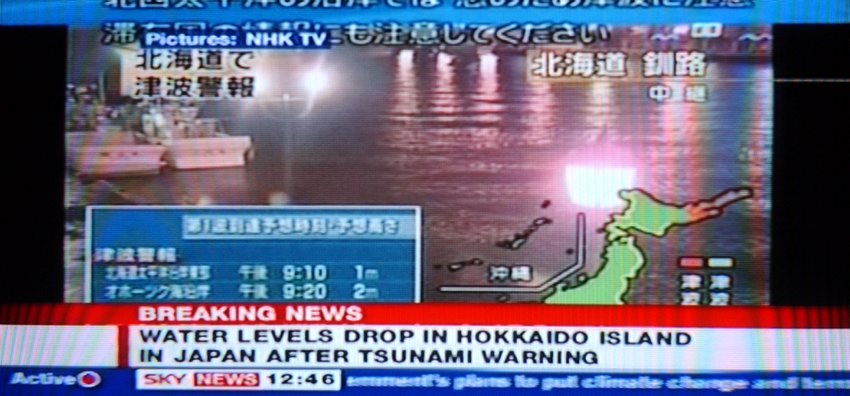
Tsunami alert in Japan after 8.1 quake


An 8.1 earthquake has hit near Japan triggering a tsunami alert in Japan. The initial reports were that the tsunami, if there were one, would hit the coast between 12:10 GMT. As yet there have been no signs of a tsunami but the tide has dropped 20 – 30 cm on some coastal areas. As this story develops 12:54 there were reports of a 0.5 metre high wave hitting the fishing town of Nemuro. The earthquake hit near the Kuril islands [46.683N, 153.223E] north of Japan at around 11:15 GMT [22:14 local time].

Tuesday, November 14, 2006

Iraq - 150 kidnapped as UK/US talks start


Another week in Iraq started with yet more bombings and attacks. Today [Tuesday] up to 150 people were kidnapped by insurgents. They were taken from a research institute belonging to the Iraqi Ministry in the Karradah district of Baghdad. Latest reports suggested that 3 people had already been released [CNN/BBC]. It is said to have been the largest mass kidnapping seen in the country. Witnesses said the street filled with pick-up trucks carrying insurgents dressed as police.
There has been a continued rise in attacks from the Iraqi insurgency. Each month brings with it a greater number of attacks with little respite. On Monday this week at least 11 were killed in a suicide attack [BBC] and on Sunday two suicide bombing killed thirty five. Civilians are the main victim in this dirty war, but highly protected troops are still taking losses. On Sunday a boat carrying British personnel was targeted with an IED or ‘improvised explosive device’ the MoD confirmed. Today they were named as Warrant Officer Lee Hopkins, Royal Corps of Signals, and Staff Sergeant Sharron Elliott of the Intelligence Corps. Also killed in the attack were Corporal Ben Nowak of 45 Commando Royal Marines and Marine Jason Hylton of 539 Assault Squadron Royal Marines [BBC]. The attack brings the coalition dead to 3099, 125 of them British.
The political fallout has not affected Washington’s stance and last night PM Blair of Great Britain blamed both Iran and Syria for helping the insurgency [CNN].
Michael Cox, Royal Institute of Affairs, speaking on CNN said there was a difficulty with engaging Iran and Syria after the disaster in Iraq. On Iraq he said, “The situation there is very bad and getting worse by the day” and it was difficult for America as to “how to withdraw without making it look like defeat”. Whether Tony Blair can motivate US representatives in finding a way forward in the push for peace in the Middle East can only be guessed [BBC]. Speaking via a video link he told the US inquiry into future policy options that resolving the Israel-Palestinian conflict is crucial to the future of Iraq. The ISG is expected to report its findings to President Bush within weeks. Posted by Picasa

China pressured to stop piracy


US Commerce Secretary, Carlos Gutierrez has pressured Chinese authorities to clampdown on pirated DVDs in an effort to reduce effects of intellectual property rights infringement. Gutierrez praised the Chinese leadership for tackling the problem adding that it was “a large problem for all parties”. $2.4 billion per year is lost by US companies due to piracy in China, according to a report on CNN today. It is an issue which has been brewing for a long time and prompted some companies to take actions themselves. Warner Brothers are set to release a Mandarin version of the new Superman film on DVD in China ahead of the rest of the world [BBC]. Fox has also made attempts to thwart the pirates by releasing cheaper DVDs [English Peoples Daily]. According to the agreement, Twentieth Century Fox Home Entertainment will distribute its products through Zoke's extensive national network, and supply China's growing home entertainment market with recent releases as well as celebrated films from the studio's vast library. But the efforts may well fall flat on Chinese consumers. A Chinese worker often earns less than $200 a month and pirate DVDs offer value for money at less than the equivalent of $2 each. Beijing is said to be clamping down on ‘serious violators’ but according to CNN, this move is only forcing many vendors underground. Liu Binjie, Press and Publication ADM, said that there needed to be more education in schools about intellectual property rights. “We will also educate the general public to help them realize that buying pirated goods is wrong”. Frank Hawke highlighted the danger that pirated goods could pose to the public. “They will move from luxury goods and DVDs and CDs into pharmaceuticals, chemical intermediates, food additives electronics, electric products and these are products where you have serious safety issues.”
The risk to China’s economy is very real. According to Carlos Gutierrez, “China is evolving and moving towards an innovation economy, and I know there is a vision President Hu [Jintao] has laid out for an innovation society, and you can’t be an innovation society if you can’t have an innovation society when you can have of intellectual property rights protected”.
But it will be an uphill struggle to see off the vendors of pirate DVDs. And whilst Beijing is seeing a clampdown, in other provinces DVDs are sold openly in shops and on the streets. Posted by Picasa

Thursday, November 09, 2006

US - One door shuts another gate opens


The last 48 hours have brought little comfort for the Republican Party. “I thought we’d do better,” said President Bush to a packed press room, “But what do I know?”
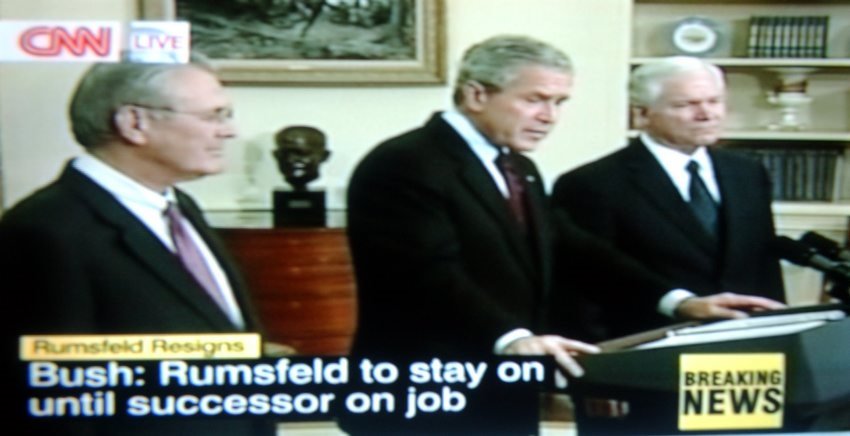
At that point all he knew was that his party had lost control of the House of Representatives. There were still some known unknowns to come. And the news hit news networks like a bombshell. Donald Rumsfeld had resigned as Defence Secretary. President Bush announced the departure of his loyal aid as his replacement stood aside him. ITN’s John Irvine [UK’s Independent Television News] described Rumsfeld as “standing there like a criminal” as George W Bush introduced his successor, Robert Gates.
The report was generally scathing of Rumsfeld and his legacy. “Last week Bush said Rumsfeld wasn’t going anywhere” the report started as saying, “but following the disastrous mid-term election results the Republican Party was, it seems looking for a new strategy.”
Rumsfeld had already offered to resign twice in the past, but the pressure was on Bush to make changes. The “face of the Iraq war” who had been the “hawk at the President’s side, and a thorn in the side of others” had himself become a casualty of the political war. “You go with the army you have”, Rumsfeld had said, when questioned over troop numbers and equipment deployed in Iraq. But numbers of troops on the ground were lacking and an insurgency soon enveloped the country. “Stuff happens” was Rumsfeld’s response to the various pitfalls that befell the US troops. ITN’s Juliet Manyon said “the real dilemma for America is they can’t leave Iraq, but they can’t stay either.” Of Donald Rumsfeld’s resignation he said, “it may be seen by the insurgents that their war of attrition is beginning to work.”
As Donald Rumsfeld bowed out he said, “I must say its been its been the highest honour in my life to serve with the men & women in the Department of Defence,” George Bush paid tribute to Rumsfeld’s service saying that “America is safer and the world is more secure because of the service and leadership of Donald Rumsfeld.”
The third bombshell of the day came when the last result came in shortly after midnight [GMT] a result which would decide who controlled the Senate. It all hinged on Virginia where Democrat candidate Jim Webb said in the early part of the day, “The votes are in and we have won.” But Republican Allen was still optimistic. ABC also reported on a problem in Montana where Duane Winslow, the County Election Administrator, ‘pressed the wrong button’ and deleted the already counted results. The counting of the votes had to be recounted with the whole country waiting for news as to who would control the Senate. US networks later reported that Jim Webb had won in the State of Virginia, putting the Democrats in control of the Senate for the first time since 1994 [BBC].
Rumsfeld is perhaps best known for his quote made at a news briefing in which he said, “there are known knowns, there are things we know that we know, there are known unknowns, that is to say there are things that we now know, we don't know. But there are also unknown unknowns, there are things we do not know we don't know. And each year we discover a few more of those unknown unknowns.” Whether he knew he’d be ousted as soon as he was can only be speculated. Posted by Picasa

Monday, November 06, 2006

War on Terror - UK terror trial highlights threat


A court in Woolwich heard today that Dhiren Barot planned to use a ‘dirty bomb’ and initiate a series of massive explosions to kill thousands in UK and US. Barot was arrested in 2004. According to the prosecution he had threatened the use of a ‘dirty bomb’. Other uncovered plots were said to have been hatched as far back as 2000. One plot was to explode a bomb on a tube train travelling under the Thames River in London. Another series of targets included the NYSE in New York, but, it is alleged the plans were shelved after the success of the 9/11 attacks. Dhiren Barot has admitted the charges [BBC].

This trial comes on the back of a recent report on the BBC website that Britain has become the number 1 al-Qaeda target [BBC]. Security sources told the BBC that “The situation has never been so grim”.

But as a heightened security threat persists, airline travel restrictions were once again relaxed today. From today ‘small amounts’ of liquids and gels may be carried in hand luggage. But the items must be X-rayed separately and may only be taken on European flights [BBC]. Restrictions remain in force on other flights including the US which only serves to add to the confusion of many passengers.
There were reported delays at Heathrow as the new rules came into force today with many not following the guidelines properly. The restrictions placed on passengers were implemented after an alleged plot to blow up trans-Atlantic flights was uncovered [BBC].

The War on Terror abroad, and besides worries over the back-clash following Saddam’s death sentence, there have been few reports of any violence. There was one report of a military helicopter crash in northern Iraq killing 2 US troops, but it is not believed to have been as a result of hostile action [BBC]. A curfew remains in place throughout many parts of the country, though it was ignored by many as Shi’ites celebrated and Sunnis protested Saddam’s sentencing [BBC]. The curfew is expected to be relaxed on Tuesday. The international press reaction was measured after the former leader’s sentence [BBC]. Many were of the opinion that the hanging of Saddam would do little to curb the violence enveloping the country. Al-Hayat said, “There is no reason to celebrate as Iraq was condemned to death before Saddam Hussein. We are witnessing the crumbling of Iraq” whilst the Iran’s E’temad-E Melli said, “Saddam's death sentence will make the current difficulties in Iraq more complicated” and warned of “increased tensions between the Shias and the Sunnis”. Israel’s Ha’aretz was also pessimistic. In its editorial the paper said, “It can neither close a chapter nor open a new era. It is just another death sentence - one of the dozens that Iraqi militias carry out each day against civilians from rival communities. For this reason, the verdict will also have no real impact on what is happening on the streets of Baghdad and Mosul.” Other papers were far more critical of the sentence and blamed the west and more specifically the US. Pakistan’s Nawa-I Waqt was one of the most critical leading with this statement in its editorial, “We say the death sentence for Saddam is a continuation of the inhuman and wild actions started by the US after 9/11. The use of the death sentence to win victory in mid-term polls is the worst game to play. We think the US President Bush, Rumsfeld, and Condoleezza Rice have committed far more crimes than Saddam”. Western papers varied with their opinion. The Sun in the UK was far more scathing of the ‘liberal hand-wringing’ and went on to say that although “The death penalty may no longer be the British way” it was up to Iraq as to how they applied their justice system. “Let’s hear no more about Saddam having greater influence as a dead martyr than a live prisoner. Locked up, he would be a potent figurehead for Iraq’s insurgents” the Sun went on to say. The New York Times highlighted the fact that Saddam Hussein “got a fairer trial than he ever would have allowed in his courts. But Iraq got neither the full justice nor the full fairness it deserved”. It is likely that Saddam with not be judged on many other charges including the massacre of over 5,000 Kurds in Halabja in 1988. Posted by Picasa

Sunday, November 05, 2006

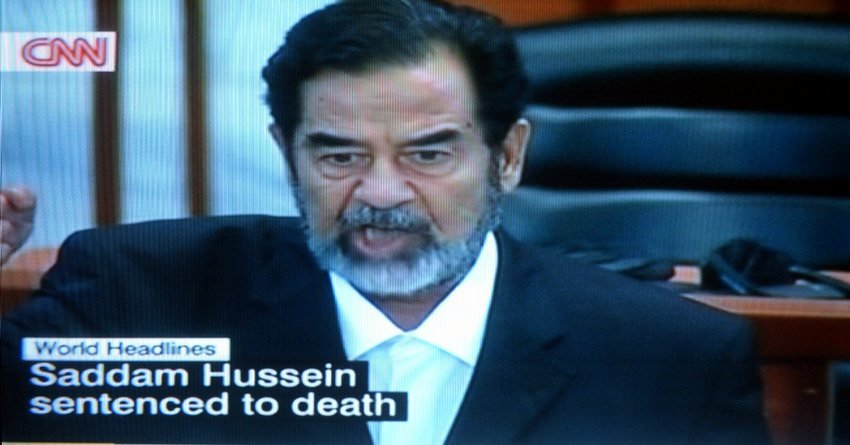
Saddam sentenced to death


Saddam Hussein, the former President of Iraq, has been found guilty for his part in the massacre in Dujail in 1982. The judge in the case then handed him a death sentence which may be carried out within two weeks [CNN]. However an automatic appeal may delay proceedings. As the judge read the verdict, Saddam shouted “down with the invaders, we are the people of this land, I curse the agents, God is Great, you are a mouthpiece of colonialism… “. After several minutes the judge ordered he be removed from the court. “Take him out” he said. The cameras did not show his removal, but Saddam was heard to shout “long live Iraq, long live the nation”. Then he left with a smile on his face [BBC]

Outside the court the US and Iraqi military are braced for any back-clash. But initial scenes on the streets of Baghdad were ones of jubilation. Saddam’s demise leaves little comfort for a country in turmoil since Operation Iraqi Freedom was initiated.
Nuri al Maliki, the new Iraqi Prime Minister said the “Saddam era is over” and continued by saying, “There will be no more mass graves”. However thousands lie in unmarked graves since Saddam was deposed. Militia on both sides have left thousands dead in kidnappings, executions, shootings, and suicide bombings. Others have been killed and maimed by coalition attacks. Others are said to be suffering effects of Depleted Uranium poisoning. D.U is used for armour piercing shells by some coalition forces [The MoD denies D.U has any health risks]. Security is almost non existence since the invasion and life for the average Iraqi is uncertain.
Over 2000 took to the streets in Tikrit, Saddam’s home town, firing guns in the air and carrying pictures in support of their former leader.

World reaction was general in full support of the verdict and sentence. Iran said it supported the judgement. The White House called the judgement “a good day for the Iraqi people” [Sky News / BBC]. But the country slides further and further towards civil war with no end in sight. Posted by Picasa

Thursday, November 02, 2006

Iraq - debates continue as death toll rises


An intense debate in the UK parliament failed to convince the majority of MPs to vote for an inquiry into the Iraq war [BBC]. Many members of the house urged a review of mistakes made and what might be done for the future, but after more than four hours of debate 298 MPs voted against the proposal, a majority of 25.
Meanwhile Democrat John Kerry was stirring controversy in the US with a ‘joke’ he made during campaign trail. He has since apologized, but he has been ostracised from other Democratic meetings. “I sincerely regret that my words were misinterpreted”, Kerry said late yesterday. But many will not let his comments go. He had urged students to study hard and pass their exams and ended with the line, “If you don’t do well, you may well get stuck in Iraq”. Many have interpreted this as a slur on the intelligence of the average marine fighting in Iraq but Kerry insisted it was intended to be an attack of Bush’s recruitment policy. Bush said last night that “anybody in a position to rule country ought to understand the consequences of words”.

However many Democrats were urging the debate be moved on. One said “forget what he [Kerry] said about Iraq, look at the actions of what Bush has done in Iraq” [CNN].

Meanwhile the situation in Iraq continues to spin out of control [CNN]. On Monday, 30 died and 60 were injured in a blast in Sadr city, in north east Baghdad. At least 50 others were killed around the country [BBC]. Tuesday brought further attacks. In one incident 15 were killed and at least 19 were injured when a bomb ripped through a wedding party on the outskirts of Sadr city [BBC]. Violence on Wednesday took at least 27 victims. A police officer was one of three shot dead in the northern town of Mosul, and at least three bombs in Baghdad killed four. And as October drew to a close, another US soldier was killed. He was the 105th US soldier to die in October and the 2,819th US troop to die since the conflict begun in March 2003. In total 3,058 coalition troops have died in the 1,323 days of conflict [icasualties.org]. A conflict that is likely to continue for many months to come. The US military says it may be more than 18 months before the Iraqi forces can take over fully from the coalition forces. Many Iraqi forces have been infiltrated by insurgents and there are estimates that connections to such militias can be as high as 70%.

In Afghanistan the situation is little better. Battles continue against the Taleban daily. But the US forces are stretched thin. There are less than three soldiers for every mile of the Pakistani border which stretches some 400 miles. Five hundred and three coalition troops have died in Afghanistan since November 2001, with seventeen killed in October. The highest death toll this year was September when 38 troops were killed, six of them from the US. The major turning point was February when casualty numbers jumped from 1 in January to 17. Only April saw a major drop in the number of troops killed with only 5 reported deaths. 2005 also saw a high casualty rate, topping 130 in 12 months. But there were lulls in the fighting with only 5 months showing casualty rates in double figures. Total casualty figures for 2002, 2003 and 2004 reached only as high as 68. The total for the first three years of conflict totalling 195, including 12 that died in less than two months of conflict at the end of 2001. Posted by Picasa

Tuesday, October 31, 2006

Iraq inquiry - UK Parliament debates


"What a tangled web we weave" - David Blunkett
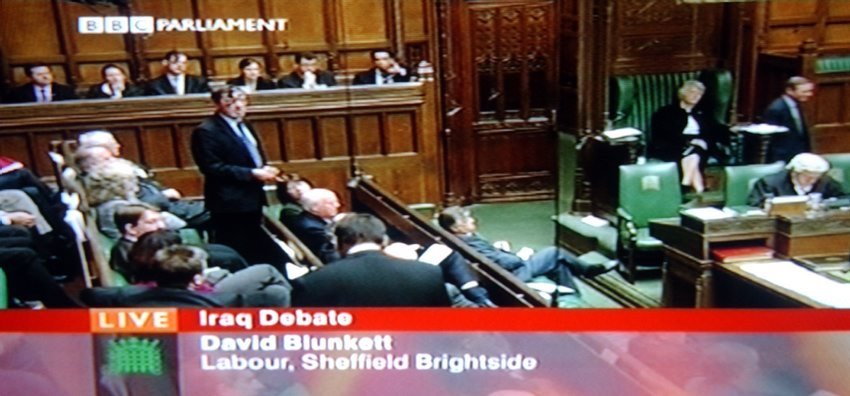
Whilst the bombings and attacks in Iraq take nearly one hundred lives in just two days a debate was launched in the UK Parliament to discuss the possibility of initiating a public inquiry. The Foreign Secretary Margaret Beckett gave a resounding ‘no’ to those calling for such an inquiry and refused to make any commitment to an inquiry after troops had left Iraq. She said it “was not sensible to have an inquiry at this time”. She said that any inquiry would “send the wrong signal to those that might do us harm” that Britain’s commitment was not substantial. The Plaid Cymru MP opened the debate by saying the Iraq war was a "monumental catastrophe", which was about "the breakdown in our very system of government". Both Malcolm Rifkind MP, a former Conservative Party Defence Secretary, and Ken Clarke, former Conservative Party Chancellor of the Exchequer, both challenged her on not making a commitment to any future commitment to an inquiry. Ken Clarke MP said the Commons could send a "very united message" if an inquiry like the Franks inquiry, held after the Falklands war, could be promised. She reiterated her earlier comments that it was not the right time to announce such an enquiry. Another opposition MP, Douglas Hogg said the government's argument that an inquiry should not happen while the war was still happening was similar to that used by Neville Chamberlain's government during the troubled Norwegian campaign in 1940. (A debate at that time was forced by MPs and the size of the vote against the government led to Mr Chamberlain's resignation and Winston Churchill becoming PM). She insisted in her statement to the house that the situation in Iraq was getting better. “Besides the violence we are still making strides in the country…”, but she was again interrupted and asked why she was dismissing the prospect of any further debate as to the situation in the country.

Shadow Foreign Secretary William Hague conceded agreement that debate about the future of Iraq was more important than looking back to the past. “What ever our position on the reasons for war… there are lessons to be learnt” He added that, “Any inquiry should debate what should happen in the coming months”, but he asked that date be set for such an inquiry. He said that the argument that such an inquiry would undermine moral within the British Army did not “hold scrutiny”. He acknowledged there had been positive developments in the country but insisted the government should examine the lessons of where mistakes had been made in Iraq.

David Blunkett stood to say, “What a tangled web we weave”. The commons fell into laughter. He then went on to describe the opposition as “hypocrites”. Liberal Democrat Foreign affairs spokes person Michael Moore described the ever increasing casualty list, 2000 dead Iraqi civilians and nearly 100 US troops this month alone, and went on to say “if now is not the time to have an inquiry, when is?” He asked why if President Bush can change his mantra of “staying the course”, why Tony Blair and his government could not change. He was referring to comments the President had said on the 11th October. Bush had said, “If what we’re doing isn’t working, then it’s time to change what we’re doing”.

MPs are set to vote at 19:30 GMT on the proposal. The SNP and Plaid are using their "Opposition Day" to table the motion calling for a committee of seven senior MPs to review "the way in which the responsibilities of government were discharged in relation to Iraq". [BBC] Posted by Picasa

N Korea - 6 Party Talks to 'start in weeks'


"Is the nuclear test by the DPRK for the purpose of seeking security guarantees?"
China was seriously concerned by the nuclear test.

Just twenty days after North Korea announced it had tested a nuclear weapon the Six Party Talks may be reinitiated. Chinese and US officials have had ‘informal’ talks with North Korean representatives and according to reports talks may start within weeks [CNN]. U.S. Assistant Secretary of State Christopher Hill said Tuesday that six-party talks on North Korea's nuclear program could resume as early as November or December. The Chinese Foreign Ministry said earlier Tuesday that the chief envoys to the negotiations from China, North Korea and the United States held an informal meeting in Beijing and agreed to resume six-nation talks.
If talks restart, Japan, Russia and South Korea would also be involved. But while Japan welcomed the prospect of a new round of talks, it "does not intend to accept North Korea's return to the talks on the premise that it possess nuclear weapons," public broadcaster NHK quoted Foreign Minister Taro Aso as saying. Russia’s Deputy Foreign Minister Alexander Alexeyev described the announcement as “extremely positive” whilst South Korea's Foreign Ministry spokesman Choo Kyu-ho said he hoped such talks would bring a swift cessation of North Korea’s nuclear program. The Six Party Talks stalled a year ago after Pyongyang pulled out in protest at US financial sanctions imposed upon it. The UN imposed further financial and arms sanctions earlier this month after North Korea alarmed the world by testing a nuclear weapon on the 9th October [BBC]. Diplomatic efforts proceeded quickly following the test with Chinese Premier, Hu Jintao calling US President George W Bush within hours of the explosion. Chinese State Councilor Tang Jiaxuan later vitisted the United States and Russia on October 11th as Hu's special envoy. Later Tang visited the DPRK, also as Hu's special envoy, and DPRK leader Kim Jong Il met with Tang on October 19th . ROK [South Korea] President Roh Moo-hyun visited China, where the leaders of the two countries agreed to work more closely on the issue. U.S. Secretary of State Condoleezza Rice then followed up with a visit to China on October 20th. [Xinhua News].

Wednesday, October 25, 2006

tvnewswatch - Return from China


China's news media can often leave one in the dark
Three weeks in China has sadly left tvnewswatch offline with only one post made since the end of September. That post was made using the previously set up e-mail to blog facility. Blogger.com does not work in China, and of course news is also difficult to get, unless staying at a western hotel. A western newspaper was impossible to obtain. China Daily, one of few English language newspapers, was not available outside big cities. In top hotels CNN and BBC World was available. Of course such hotels are well out of reach of the average Chinese citizen. A monthly salary of a Chinese citizen in a good job might just cover two nights at the Beijing International, Sheraton or Hilton hotels. The internet was the only reliable source of news outside China, though many sites were blocked. These included the BBC [though paradoxically a previously saved link in Real Player™ did open BBC World Service, BBC London and BBC 5 Live], Wikipedia and Blogger. Connections, where available, were however generally slow. All this left tvnewswatch in the dark as to furore over the veil, which dominated the British press for days after Jack Straw’s comments. The continuing violence in Iraq was rarely seen on China’s news media. CCTV-9, never the best for news, concentrated more on China’s economic development. It is the economic development that strikes the outsider on their first visit to this vast country. Construction of new buildings, factories and roads is widespread. The number of 4x4 vehicles and modern cars would probably surprise many westerners. But of little surprise was the increased pollution. Even over the smaller towns, smog, made up of traffic fumes mixed with the output of local factories and power stations, hung in the air. Beijing has a reputation for having high pollution levels, and, for the few days tvnewswatch was there, the visibility was little more than 2 or 3 city blocks. A taxi driver’s insistence that it was low cloud was not at all convincing. The North Korean nuclear test did hit the headlines in China. A BBC World Service report did help fill in the gaps of information gleaned from the Chinese media. By chance tvnewswatch had internet access at the time of this Breaking story and was able to report from China, besides restrictions on the Blogger.com website. As described above this was achieved by the post by e-mail facility, but it has to be set up ahead of time. Several days later CNN were reporting that radiation had been detected near to the test site, thus confirming the test was real and not as some had speculated, a bluff.
North Korea's nuclear test on the 9th October created consternation around the world since it was announced by the North Korean government. China unusually backed resolutions set by the UN which imposed sanctions on the country. There has been, however, criticism by some countries that the blockade was not being enforced strongly enough by Chinese authorities. Talks initiated by China with the North Korean regime have failed to bring any positive results. But besides the rhetoric coming from the US government over the past year with regards their promised serious consequences if the country should obtain nuclear weapons. Another country in Washington’s sights is Iran. Today, the Iranian government announced the opening of a new enrichment plant. The Iranian government continue to insist their nuclear industry is merely to generate electricity, something strongly disputed by western governments.
But there still remains the unfinished missions of Operation Iraqi Freedom and Operation Enduring Freedom. The US President George W Bush said today he was still optimistic for the future besides airing his concerns. "I know many are not satisfied with the situation in Iraq , I'm not satisfied with the situation either" he said today. The violence has gone from bad to worse throughout the month of October and it has been the deadliest month for US troops since October 2005. Ninety one have died and more than 150 have been injured in the last 25 days. Hundreds of Iraqis have died in the same period. And with worsening violence coming from both Sunni and Shi'ite militants, the opinion polls are showing a strong disapproval rating for both Bush and the Republican party. But besides the criticism and increasing death tolls George W Bush was still upbeat. "I know the American people support the war as long as it's a path to victory". He asserted his resolve to stay the course saying, "You can't leave until the job is done". The war continues too in Afghanistan with heavy fighting reported in recent days west of Kandahar. There are 21,000 US troops and 20,000 UN troops in the country continuing to battle the Taleban which has strengthened in the last few months. A total of 11 coalition troops have died so far this month in Afghanistan including 4 US troops.
The veil debate was in full swing as tvnewswatch returned to London. Unaware that such a debate was even brewing, an interesting situation occurred at Heathrow as a fully veiled woman passed through passport control unhindered and without unveiling to the female official. Whatever one’s personal views, there certainly appeared to be an issue of security. It was a surprise to find this was the subject of a tabloid frenzy when confronted with the media from the past 20 days. Posted by Picasa

Tuesday, October 10, 2006

China angry over N Korea N-test


China has reacted angrily to North Korea's announcement that it has tested a nuclear weapon. The China Daily said in its Tuesday edition that North Korea went back on its word that it would not test any nuclear weapons. Many other Chinese papers were leading with the story with varying strengths of condemnation.

The leading world powers have already met at the UN to discuss possible retaliation to North Korea's test. The UN Security Council has proposed several sanctions against the country. President Bush has condemned the test calling it "provocative". South Korea has called for a new look at its relationship with their neighbour, whilst Japan has called the test "unacceptable". But whilst initial talks at the UN Security Council went well, it is unclear whether China and Russia will back any resolutions. Both countries have a history of abstaining from UN Security Council resolutions.


Other countries have been less hostile to North Korea 's test. Iranian State TV has said the test was a reaction to western hostility and said other countries threatened by the west may follow suit.

Monday, September 25, 2006

Bin Laden - 'Dead or Alive'?


L'Est Republicain which reported his 'death'

There has been a surge of speculation as to the fate of America’s most wanted this weekend after the publication of an article in a French newspaper. The article published in L'Est Republicain reported that the head of al-Qaeda was dead. Usama bin Laden, Osama bin Laden or Oussama bin Laden [there is no definitive spelling of his name (أسامة بن لادن) in the west] had, according to the article, succumb to a water-born disease, namely typhoid. The paper cited “Usually reliable sources” which indicated the Saudi security services had spotted the militant Islamist leader in Pakistan on 23rd August 2006. The report went on to say that bin Laden was suffering “partial paralysis of his lower limbs” and that the situation was such that “medical care would be impossible”.

Confirmation of his death
However there is still uncertainty as to whether the fugitive is dead or alive. The “usually reliable source” said that the Saudi security services received a report of his death on the 4th September 2006, but were awaiting further details before announcing the death officially. The collected intelligence by the French Secret Service [DGSE] was, according to L’Est Republicain, reported to the highest French authorities. The US has refused to make any official comment on the reports, Condoleezza Rice saying only, “No comment, and no knowledge”. And the French Prime Minister, Jacques Chirac, was seemingly more incensed by the leak of information and called for an immediate inquiry. CNN could only add to the rumours and speculation by quoting an un-named Saudi security source which indicated that they were aware that bin Laden had a ‘water-born disease’ but could no say whether he had died. But the BBC reported the Saudi authorities as saying they had no evidence of the terrorist’s demise. "The Kingdom of Saudi Arabia has no evidence to support recent media reports that Osama Bin Laden is dead," the Saudi government said. And Pakistan's ambassador to the US, Mahmud Ali Durrani told BBC News 24 that he doubted the claims were true. "It would be very nice to confirm that he is dead - in Pakistan, Afghanistan, New York or wherever, but I think such claims are unsubstantiated." Whether or not Osama bin Laden is dead, the War on Terror continues, as does the ‘global jihadism’ which according to one report in the New York Times suggested that the War in Iraq had exacerbated. The report said, “The Iraq war has made the overall terrorism problem worse.” At least 9 died in the most recent bombings in Baghdad [CNN], and recent UN figures showed more than 6,000 had died in terror attacks in July and August. Coalition losses also continue to rise with total losses now hitting 2,937. Afghanistan fairs little better with increased attacks on coalition forces, civilians and Afghan officials. On Monday a top Afghan official was killed by gunmen [BBC] and last week 19 construction workers were killed in a bomb blast [BBC]. At least 35 coalition troops have died in September thus far, six more for the whole of August. It brings the total losses to 483 since 2001. Posted by Picasa

Thursday, September 21, 2006

UN General Assembly - 3 days of rhetoric


Opposing views - UN General Assembly, a war of words
Three days of speeches have made interesting viewing as world leaders and their representatives have attacked each other. Day one started with a speech from US President George W Bush [BBC]. His speech was filled with his continued attacks on Iran and a defence on the continued War on Terror. "A world beyond terror where the extremists are marginalised by the peaceful majority" is in reach the President said. Of Iran he said that they “must abandon its nuclear weapons policy.”
And today the president declared he would send troops into Pakistan to catch bin Laden [CNN]. with or without permission from Gen Pervez Musharraf , the Pakistani leader. Musharraf responded by saying he would not be happy at such a decision, "We wouldn't like to allow that at all. We will do it ourselves." Meanwhile the events on the ground continue to become more deadly for civilians and coalition troops alike. Over 6,500 have died in July and August, 5,000 in Iraq alone [Source: UN]. And while neither Afghanistan nor Iraq shows any sign of calming, guns are poised and aimed at the next country on the list in what has been described as the Axis of Evil. But whilst Bush continues to criticize Iran’s nuclear policy, he refuses to meet with his Iranian counterpart. Bush said the United States has agreed to talks with Iran "only if they verifiably suspended their enrichment program.” Bush addressed the Iranian people directly during his speech, telling them that Americans "respect" their country and that they "deserve an opportunity to determine your own future.
The United States and Iran have not had diplomatic ties since 1979, when Iranian militants, who had overthrown the U.S.-backed Shah Mohammed Palavi, seized the U.S. Embassy in Tehran and held American diplomats hostage for more than a year. Bush labeled Iran part of an "axis of evil" in 2002, along with Iraq -- which the United States invaded the following year -- and North Korea.
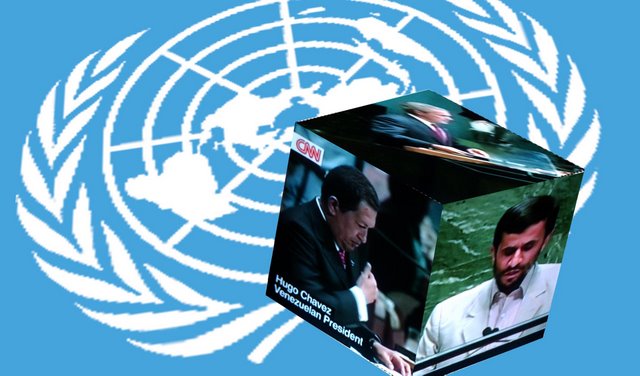
Iran’s president Mahmoud Ahmedinejad was the next high profile leader to take the rostrum. Throughout his lengthy speech Ahmadinejad criticized what he called the "abuse" of the Security Council by "hegemonic powers." He mentioned the United States by name only once during his speech, but criticized major powers he said "seek to rule the world relying on weapons and threats.”

Then it was Hugo Chavez’ turn to pour scorn on the US [CNN]. And he certainly took the prize for the most colourful of speeches as he launched a personal attack on the US president. “Yesterday the devil was right here”, he said. “Right here, the devil himself, and I can still smell the sulphur” he added. His attack didn’t stop there. As he continued he said the US president, “Spoke as though he owned the world” and accused him of trying to be a ‘world dictator’. "As the spokesman of imperialism, he came to share his nostrums to try to preserve the current pattern of domination, exploitation and pillage of the peoples of the world. An Alfred Hitchcock movie could use it as a scenario. I would even propose a title: 'The Devil's Recipe.' " He criticized the ineffectiveness of the UN saying that the General Assembly was "merely a deliberative organ" that meets once a year. “We come here and make speeches” he said, but "We have no power, no power to make any impact on the terrible situation in the world."

Emile Lahoud speaking Thursday described the “barbarous aggression” against his country by Israel which “all but destroyed Lebanon’s hope for being a viable state.“ The Lebanese president then asked, “How many children are going to die before the world community stands in defence of the rightful cause?” And he poured scorn at Israel. “It is time to ask Israel to abide by UN resolutions,” he said.

As the leaders attempted to sort out political strife in the General Assembly, two countries are gripped by political scandals. In Hungary riots and protest are continuing for the third day after revelations that the Prime Minister had ‘lied to the people’ [BBC]. Meanwhile Thailand’s political future appears from certain after the leader of the coup, Gen Sonthi Boonyaratglin, declared that free elections may not be held for up to 2 years. Restrictions have also been placed on any form of political protest and the forming of any opposition parties. There are also a number of reporting restrictions put in place [BBC]. Posted by Picasa

Wednesday, September 20, 2006

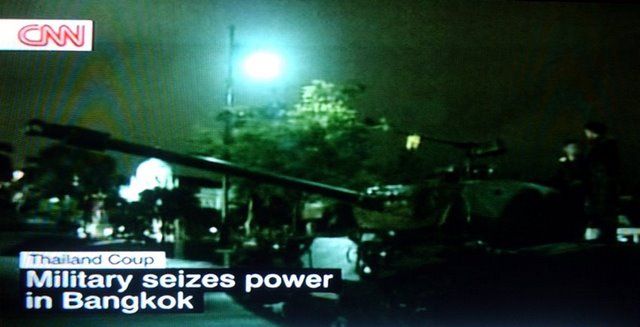
Thailand: Military seize control from PM


Tanks and troops are on the streets of Thailand’s capital Bangkok after the military launched a coup against the beleaguered Shinawatra government. The situation seems to be ‘well ordered and calm’ according to Sky Correspondent William Owen who reported live from Bangkok. Outside Bangkok it is difficult to gauge the situation and CNN and the BBC as well as other networks have been shutdown. The Party of Democratic Reform is said to be behind the coup and a state of Martial Law and a suspension of the constitution has been declared. Meanwhile Thaksin Shinawatra, the Thai Prime Minister is in New York, attending a UN conference. He has said he still considers himself Prime Minister, but it is not known when or if he may return. The Military Coup comes only three days after Thailand was rocked but a series of bombings by Islamic fundamentalists. The 7 bombs killed four and injured up to seventy.
The Australian government has said their citizens should rethink their plans if travelling to the country. The British Government has issued no advice and say they are ‘monitoring the situation closely’. The coup has affected many stocks around the world and European markets were down nearly 1% at the close. Posted by Picasa

Monday, September 18, 2006

Thailand Terror - Exclusive eyewitness report


Islamic terrorism has hit Thailand in attacks which are sure to rock the country’s tourist industry. The attacks came in a series of bomb blasts on Saturday night as people were drinking and eating in bars and restaurants in the tourist centre of Hat Yai. It is the furthest north that Islamic terrorism has hit in the country and will come as an unsettling move for the Shinawatra government.

The first reports filtered through at around 15:00 GMT with CNN breaking the news to international viewers. Other broadcasters including the BBC brought little coverage of the bombings which killed at least 4 and injured many more.

Speaking exclusively to tvnewswatch, tourist Robin Chakrabarti described what happened immediately after the blasts. “I was in the Swan Bar at the time of the first blast – which occurred around 100 metres away at a place called the Big Wonder Bar which is part of the Odeon Shopping Centre. And there was another blast in a Tuc Tuc which was parked outside. And the third bomb was almost half way between The Swan and the Odeon and I was almost level with it when it went off.” 


He then went on to describe the moments after the blast. “When I heard the first one, it was like a dull thud, and I thought, ‘That sounded like a bomb’, and I looked out the door and saw smoke coming out of the building down the road and heard a Thai guy shouting, ‘It’s a bomb’ in English, and then myself and two other guys jumped over the wall in front of the restaurant, ran down the street about a hundred metres to see if we could help. And we could see smoke and fire coming out of the Big Wonder Bar where later we heard that two people had been killed. But we couldn’t get close because then there was another explosion when this Tuc Tuc, a mini-bus thing, blew up. So I said, ‘Let’s get out of here there might be bombs all over the place.’ And as we made our way back there was the third explosion. And I was on the phone to my girl friend at the time and I said, ‘Did you hear that? That was another one’. That was a motorbike bomb which went off just across the street from me and blew shrapnel everywhere.”

The British tourist, from London, said the bombs weren’t powerful enough to blow buildings up but did blow out the front of the nearby shops. He spoke too of the how fortuitous he was not to have been injured. “I was lucky really that these cars were in the way else I’d have got my legs blown off probably. I got one guy into an ambulance with a gash to his leg. But the police and emergency services were on the scene very quickly.”

After making his way back to the Swan bar he found a number of tourists cowering at the back. “I tried to persuade them to leave and one Welsh girl said to me, ‘Do you think it’s safe outside?’, and I said, “No, but I don’t think it’s safe anywhere, three bombs have gone off already, and this is the third most popular part in the street, there might be one in here for all we know. There’s some parked cars outside and I don’t know who owns them. Who knows, let’s get out of here”. We went out quite quickly and the Welsh girl and a guy from Northern-Ireland, they didn’t know the town, so I said, “You can come with me and take some backstreets where there were no people and no traffic”. So we took the back streets to their hotel to avoid the streets where the bombs had gone off, and we got back alright.”

“One American guy I was with that night is now too scared to go to his hotel after receiving a shrapnel wound the night before. He has been bussed back to Bangkok with the help of the authorities. He was going to get a job here, but now he says he is too afraid.”

Many of the tourists have also fled the area following the blasts. “Many of the Singapore and Malaysian tourists have already left”, he said.

In all there were seven bombs. The two outside the Odeon shopping centre and one outside the Brown Sugar bar. The four others were up to two kilometres away at Lee Gardens, the Big C and the Diana, all shopping centres, and at a railway station in Hat Yai.

Of those killed, one was a Canadian; the first Westerner to be killed by terrorists in Thailand . He was an English teacher who had worked at Pholwittaya School, a 35 year old named as Jesse Lee Daniel. At least 70 people were injured in the attacks. The blasts were the latest in a string of violent incidents in the restive south, where more than 1,500 people have been killed since January 2004. Posted by Picasa

Monday, September 11, 2006

9/11 - fifth anniversary starts with threats


Further threats come from al-Qaeda on fifth anniversary of 9/11

Saturation coverage of the events surrounding America’s worst terrorist attack has begun. CNNi began the day with Remembering 9/11, an hour long special looking back at the attacks, the tributes, and statements from world leaders.
Business International continued with an overview of today’s events and a look back at the attacks which killed 2,973 [The death toll from the twin towers was estimated at 2,749, including the 87 passengers aboard American Airlines Flight 11 and the 60 on United Airlines Flight 175. Among the dead were 60 police officers and 343 firefighters who responded to the scene. Another 125 died at the Pentagon with a further 59 perishing on flight 77. Flight 93 which crashed in Pennsylvania took with it 40 lives. The 19 hijackers are not included in these figures - source].
Sky News broke their continued coverage to bring viewers a Live broadcast from Lebanon where Prime Minister Blair is continuing his Middle East tour. He has already met with Ehud Olmert, the Israeli Prime Minister, and Mahmoud Abbas, the Palestinian leader, over the weekend. Today, in his address, he said Britain was committed to bringing about a lasting peace in the Middle East. His speech was briefly interrupted by a female protester who unfurled a banner reading “Boycott Israeli Apartheid”. As the protester was led away Siniora said, “It’s alright, we live in a democracy, and we are willing to listen to all views”. Siniora then read a statement in Arabic. There is a lot of anger in Lebanon towards Blair for his not having called for a ceasefire during the month long conflict. Prime Minister Blair said he was aware of the hostility towards him, but added that he wanted to meet the Lebanese president “face to face” and to understand the views of the government. Of the criticism that Blair had not been more forceful in trying to stop the violence he said, “There never was going to be a cessation unless there was a UN resolution … but my view was to get the UN resolution … and the best chance for Lebanon is resolution 1701”. The conference was not covered by any of the main broadcasters in its entirety. CNN cut away shortly after the brief protest, Sky News cut away for a commercial break, and the BBC broke for headlines at the top of the hour.

And headlines are dominated by the events of five years ago. One difference of this year’s broadcasts is that video of the plane hitting the towers is far more prominent. This will be unsettling for many that lost loved ones in the attacks. The scars have not healed for many Americans, and more especially for New Yorkers. Thousands of people are still affected by the atrocities. Many physically, from the smoke that enveloped much of Manhattan when the towers collapsed. Others still suffer the mental and emotional scars from that day. And it is far from normal in the Big Apple where five years on a large empty space still remains where the World Trade Centers once stood.

The war continues too, both in Afghanistan and Iraq. Today a suicide bomber killed at least 10 Iraqi army recruits in Baghdad, CNN has reported. And a US soldier was killed on Sunday by small arms fire in the north of the capital. Throughout July alone Iraqi government figures put the civilian death toll at 3, 438.
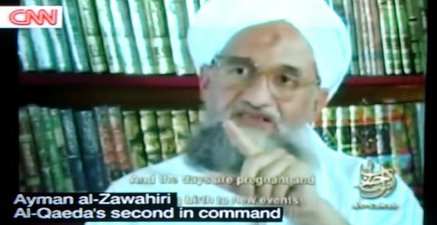
Afghanistan is still a battleground and there has been continued battles with the Taleban over the weekend leaving 150 insurgents dead according to official sources. Today also brought another message from Al-Qaeda’s second in command Ayman al-Zawahiri [CNN]. In a lengthy statement the al-Qaeda leader said that “new events” would be coming soon. Of 9/11 he said, "Your leaders are hiding from you the true extent of the disaster … and the days are pregnant and giving birth to new events, with Allah's permission and guidance." And in a statement targeted at the United State’s closest ally he said, "I want to bring to the attention of the British people that Dr. Brydon won't be returning to India this time." The comment is a reference to the sole survivor of a British army massacred in Afghanistan in 1842. The rhetoric continued in the 75 minute tape with more threats and promises. "We tell you not to concern yourselves with the troops in Iraq and Afghanistan, these are doomed," he said. "You should worry about your presence in the Gulf and the second place they should worry about, is in Israel."
Another videotape aired last week by Arabic-language network Al-Jazeera showed what was described as a meeting between bin Laden and Ramzi Binalshibh, a key plotter in the September 11 attacks. The video was said to have been made in 2001 and shows Hamza Alghamdi and Wail Alshehri who were two of the hijackers who died in the 9/11 suicide attacks. Posted by Picasa

Saturday, September 09, 2006

Space shuttle STS-115 launches safely


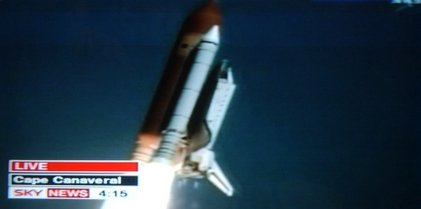
Space shuttle Atlantis has lifted off safely from Cape Canaveral in Florida. STS-115, commanded by Brent W Jett, lifted off at 15:15 GMT and is the first mission for Atlantis since 2002. It will dock with the International Space Station and NASA is set to continue building the Station, marking the first time in almost four years that a space station component has been added to the orbiting outpost. During their three spacewalks, crew members of Atlantis will install the P3/P4 integrated truss and a second set of solar arrays on the space station, doubling the station’s current ability to generate power from sunlight and adding 17.5 tonnes to its mass. [NASAPosted by Picasa

Friday, September 08, 2006

Terrorism rampant whilst Bush claims victory


Besides President Bush’s declaration that the War on Terror was making headway, the bombing against coalition forces in both Afghanistan and Iraq continue [BBC].

A British soldier has died from wounds received in an attack in Iraq on Tuesday [BBC]. In Afghanistan today a suicide bomber killed 2 US soldier and injured two others. Many civilians were also killed in the blast near a military base in Kabul. The BBC reported at least 16 dead whilst CNN reported around 13 dead in the blasts, though this was later increased. Earlier this week a British soldier was killed by a suicide bomber on the outskirts of the capital. As attacks increase, calls for increased troop numbers have been approved at a NATO meeting in Warsaw, Poland. The number of troops is likely to be in the region of 2,500. It is not clear from which countries the troops will be sent. The number of attacks in the country has risen dramatically over the last few months with at least 90 killed since January.

But it is Iraq which sees the worst violence, death and bloodshed. Bomb attacks occur almost daily and there seems to be no end in sight to the violence. This week also saw an almost symbolic handover of control to the Iraqi forces from the US and other coalition forces based in the country. But they are still small in number and ill equipped to deal with the rise of insurgency they face. The future looks far from certain and William Patey, the outgoing British Ambassador, told the BBC that he was pessimistic for the Iraqi people who themselves had no confidence in their own security services. And today a report revealed that the CIA found there was no link between Al Qaeda’s attacks on September 11th 2001 and Saddam Hussein. CNN reported tonight that there was also no evidence that showed any connection between Al Qaeda in Iraq, and its leader Abu Musab Zarqawi, and the former Iraqi leader Saddam Hussein. This counters consistent claims by the White House over the past five years.

The dark day in American history which sparked off these continuing conflicts is commemorated this coming Monday. The events of 9/11 have been the subject of a number of documentaries and extensive 9/11 coverage on many networks.

And amidst the saturation coverage controversy surrounds The Path to 9/11, an ABC docu-drama which is set to air on the 10th and 11th of September. A former National Security Adviser Sandy Berger , former Secretary of State Madeleine Albright and former President Bill Clinton have all criticised their depiction within the programme. ABC claim their programme was as accurate as they could make it but would look into allegations made. One ‘inaccuracy’ in the $40 million drama suggests Bill Clinton was too busy with the Monica Lewinsky scandal to fight terrorism. Former New Jersey governor Thomas Kean, who headed the 9/11 commission and was a paid consultant on the mini-series, said some controversial scenes in The Path to 9/11 were being removed or changed. [The Australian / BBC / CNN]

The 9/11 commemorations will culminate with a speech from President Bush who will speak to the nation on Tuesday 12th September at 01:00 GMT. Posted by Picasa

Mao's legacy, thirty years on


Few in China would proclaim the sentiments of this
poster which reads "Mao is the red sun in our heart"

Today is the 30th anniversary of Mao's death [09/09/1976] . But even in death, Mao looms large in China, but mostly as a tourist attraction as thousands visit the mausoleum, in which his body lies, daily. There will be be no commemorations for the former leader, however. China is trying to forget much of Mao’s legacy, and much of his life is being written out of the history books, according to a report today on CNN. The BBC also looks back on the legacy of the former leader and how China has moved on. According to the BBC report, the Communist party has banned open conversation of his life, an indictment to the man that changed the face of China so significantly. Posted by Picasa

Thursday, September 07, 2006

Bush's War on Terror speech not seen by millions


Whilst Tony Blair made speeches confirming his mission to continue his term in office, his key ally George W Bush was making a keynote speech in Atlanta, Georgia.

In a previous speech he has admitted that interrogation techniques employed on terror suspects had resulted in significant leads in the fight against terrorism and that CIA camps around the world did exist [BBC]. However, British viewers have seen little of the Presidents latest series of speeches. BBC showed nothing from today’s speech Live and Sky News also failed to bring viewers any coverage. Even their Sky active service had no link to the Live broadcast. CNN showed a short clip but soon cut back to the studio after a few short minutes. CNNs pipeline service gave only 3 minutes FREE viewing. During part of his ongoing speech, the President said, “We need to do everything we can to stop the next attack”. He added that there had been continued successes in the global War on Terror. “We have killed Zarqawi in Iraq … and we have over 90 nations fighting with us in the War on Terror including the democratically elected governments of Afghanistan and Iraq”. [BBCPosted by Picasa

Blair - "I won't set a precise date"


The speculation and debate over the future for Britain’s Prime Minister is set to continue after he made a brief statement to the media in which he set he would not put a timetable on his leaving office. After a short visit to a school in north London he said, “As I’ve said before, the next party conference will be my last party conference, my next TUC conference will be my last TUC, probably to the relief of both of us” and added, “I’m not going to set a precise date now, I don’t think that’s right. I will do that at a future date, and I will do it in the interests of the country and depending on the circumstances of the time… it’s important for the Labour party to understand that it’s the public that comes first … and we have to get on with business…” [Sky News] Posted by Picasa

Two more air terror plot suspects remanded


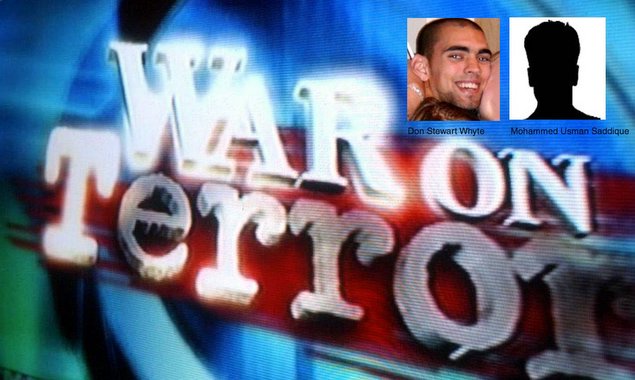
A court has remanded two more suspects connected with the alleged plot to blow up trans-Atlantic planes [BBC]. The two men, Don Stewart Whyte and Mohammed Usman Saddique, were arrested on the 10th August along with 22 others in police raids in London, High Wycombe and Birmingham. Whyte, 20, from High Wycombe, and Saddique, 24, from Walthamstow in London, are both charged with preparing acts of terrorism. Whyte also faces charges of possessing a Baikal 9mm pistol as well as a magazine clip, ammunition and a silencer. Both will reappear at the Old Bailey on the 18th September. Three other suspects held since the 10th August have now been released.

[Charges in FullPosted by Picasa

Blair's future affects FTSE 100 and Pound


Under pressure to resign: Blair's future remains uncertain

After two days of speculation and calls for the Prime Minister’s resignation, Tony Blair is expected to make a statement Thursday afternoon as regards his position. A week ago the Prime Minister said he would not lay out a time table. But he has been under pressure from a number of back bench MPs to go sooner rather than later. Wednesday’s Sun newspaper ran with a front page lead insisting the PM would leave office in May 2007. However No. 10 has denied this. The media frenzy surrounding the Prime Minister’s future has resulted in many arguably more important stories being buried [BBC]. The so called back stabbing within the Labour party has precipitated resignations [BBC] and created divisions in the party which will no doubt be exploited by the opposition in the months to come. Besides a relatively strong economy, a lowering of unemployment figures and the implementation of minimum wages, the Blair government has been highly criticised over its foreign policy. Alignment with the US in the continued War on Terror, and specifically the war in Iraq, is believed by many to be a serious mistake. The gradual decline in standards within the National Health Service has also been seen as a failure over Labour’s 10 years in power. Labour’s popularity stands as 32% compared to 35% for the Conservative party, this according to a poll shown on CNN. The US broadcaster has given some airtime to the story, but BBC 24 and Sky News are covering little else. Helicopter shots of Tony Blair leaving Downing Street, arriving at a school, leaving a school and continuing commentary from ‘experts’ is filling much of the broadcasting today. And all wait with baited breath for the Prime Minister’s statement. All the uncertainty in the meantime is creating a wavering financial market. There are no changes in interest rates but the Pound has fallen along with the FTSE 100 in the wake of the speculation over the Prime Minister’s future. However, the general view is that any losses will be minimal and the financial impact will be short-lived [Reuters]. Posted by Picasa

Monday, September 04, 2006

China suffering worst drought in decades


China is suffering the worst drought in decades. Reservoirs are at 33% capacity and 17 million people are without regular drinking water. The economic losses could exceed 6.5 billion yuan ($817 million) according to state news agency, Xinhua. Chongqing is one province hardest hit, but other neighbouring provinces of Guizhou, eastern provinces of Zhejiang, Anhui and Jiangxi and central provinces of Hunan and Hubei have been severely affected [Reuters]. The drought is the worst since 1891 when meteorological records began and baking temperatures of 40C are common place throughout the region [BBC].
The situation is in stark contrast with the floods which hit many parts of south-east China in the last two months which displaced thousands and killed hundreds. In August typhoon Saomai hit China and swept through Zhejiang, Fujian and Jiangxi [BBC]. More than one million people had been evacuated prior to Saomai’s landfall, but over 50,000 houses were destroyed and 104 died in the storms wake. In July up to 75 people were killed when typhoon Kaemi swept through Fujian province [BBC]. And also in July tropical storm Bilis killed 500 people, although official figures initially put the death toll at 188 people bringing with it accusations of a cover-up [BBC]. June’s monthly death toll was also high with at least 349 dying in storms. Seasonal heavy rains and typhoons cause hundreds of deaths in China every year. But meteorologists predicted 2006 would be particularly bad, with warm Pacific currents causing more typhoons than usual.
China’s battle with aberrant weather highlights what many have said are the symptoms of ‘global warming’. And today a report was published calling on greater action to tackle the ‘inevitable’. At this year’s annual meeting for the British Association for the Advancement of Science (BA), Frances Cairncross said, "[Climate change] is undoubtedly going to happen on the basis of all we know at the moment” and she urged for immediate action. One of the most thorough reports was done by the International Energy Agency in the summer, and that suggested that even if we threw at climate change all we had at the moment, even if we put it all in place, we would still see a rise in the concentration of emissions … [So] although we've got to continue taking steps to slow it down, we've also got to realise we're going to live in a warmer world." [BBC]. According to the IPCC [International Panel on Climate Change]. The world has warmed by about 0.6 degrees this last century, and the 1990s were the warmest decade on record. Scientists say average global temperatures have varied by less than one degree since the dawn of human civilisation, although they fluctuated much more before that. The IPCC predicts a global rise of between 1.4C and 5.8C by the year 2100. Rising temperatures are thought to cause sea levels to rise as the oceans expand and polar ice melts. The IPCC says sea levels rose between 10 and 20cm worldwide during the 20th Century. And it predicts a further rise of between 9cm and 88cm by 2100. Most mainstream scientists believe that increased emissions of greenhouse cases, particularly carbon dioxide, are contributing to the warming of the planet. CO2 has risen from 290 ppm to more than 370 ppm since 1870 according to UNEP [United Nations Environmental Programme]. Posted by Picasa

British troops & civilians killed in terror attacks


Terror attacks today against British troops and civilians have left four dead and 7 injured.
Two British soldiers have been killed in Iraq and one has been killed in Afghanistan. It comes two days after 14 British service personnel died when their plane, a Nimrod MR2, came down near Kandahar, Afghanistan. In the Iraqi incident a patrol in the southern city of Basra came under small arms fire and an IED attack according to MoD sources [BBC]. In another incident, a base came under attack from mortar rounds. Two other soldiers were also injured in the attack on the patrol. It brings the British casualty numbers to 117 since Operation Iraqi Freedom commenced in March 2003. The coalition body-count now stands at 2,879.

In Afghanistan a bomb attack in Kabul killed four Afghan civilians as well as one British soldier [BBC]. It brings the British death toll to 37 since Operation Enduring Freedom started in 2001 . The total casualty list for all countries involved in the fight against the Taleban is now 468, the majority of which are US troops who have lost 333.

Civilians too have been the target of terrorist attacks. In Amman, the Jordanian capital, a British civilian was amongst a number of people shot by a lone gunman today. According to eyewitnesses the gunman shouted ‘Allahu akbar’ [الله أكبر] God is great, before firing into a crowd of tourists. A British man was killed in the attack, and 5 others were injured; two British women, a New Zealander, a Netherlander and an Australian [BBC]. The city was also the target of a number of bomb attacks in November 2005. Those attacks on three hotels killed sixty. The Foreign Office has warned tourists not to travel to the area warning of a “high threat to terrorism”. Posted by Picasa

Saturday, September 02, 2006

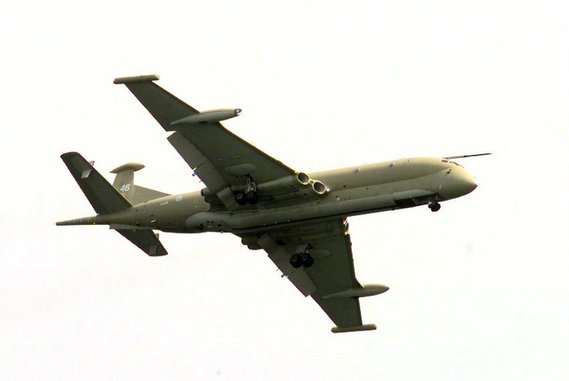
Afghanistan - Nimrod crashes killing 14


A Nimrod similar to the one that crashed

Fourteen British service personnel have died after their aircraft crashed in Afghanistan. Twelve RAF personnel, a Royal Marine and an Army soldier were on board the RAF Nimrod MR2 which came down in the southern province of Kandahar. The reconnaissance plane, based at RAF Kinloss in Scotland, belonged to the Nato-led force battling the Taleban. UK Defence Secretary Des Browne described the incident as "dreadful and shocking" news and said the indications were it was a "terrible accident". It is not clear what the cause of the crash was and officials said the incident appeared to be an accident. Tony Blair said the incident would "distress the whole country". A total of 36 British service personnel have died in Afghanistan since 2001. [BBC/Sky News/CNNPosted by Picasa