Friday, October 28, 2011

ICS for Galaxy Nexus & Nexus-S, but not Nexus One

Google's new flagship phone is likely to be on the shelves in three weeks with a date of the 17th of November pitched for the release of the Galaxy Nexus [Telegraph].

The Samsung made device, dubbed the Nexus Prime before its unveiling earlier this month, will be the first Android phone with Ice Cream Sandwich [ICS] which is set to close the gap between tablets and phones running the Android operating system [Google: Galaxy Nexus / video: Introduction to Galaxy Nexus / Galaxy Nexus unveiling].

There was talk that other Android devices were to get an Over The Air [OTA] update to Android 4.0, but many owners will be disappointed.

No Ice Cream Sandwich for Nexus One

It has been decided by the search engine giant that some devices, including the much lauded Nexus One, made by HTC, is too old to receive the software update.

Google launched the Nexus One in January 2010 but users of the device have felt increasingly abandoned by Google. The Nexus One's support forum closed on 1st of November last year, soon after the launch of the Nexus-S, made by Samsung. And users of the Nexus One had to wait months before they received the OTA update of Gingerbread or Android 2.3.4. 

While mostly cosmetic the update did bring some improvements to the keyboard and copy/paste functions. Other improvements were mostly under the hood and may not have been seen by most users.

But fans of the first proper Google phone will be disappointed to learn they will not get the upgrade to Android 4.0 or ICS. In many respects this will not be an issue since much of the functionality of ICS would be lost on older devices.

Technological advances

ICS allows for facial recognition, which may be employed to unlock the device. However the Nexus One does not have a front facing camera, making such a facility somewhat redundant. The ease of video calling is also lost on the Nexus One for the same reason.

There is better integration of Near Field Communication [NFC] technology in ICS. Again the Nexus One loses out since it has no inbuilt NFC chip. NFC allows contact-less payment using Google Wallet and may also facilitate the reading of NFC chips deployed in museums or on retail displays to obtain more information or an audio or video presentation. NFC can also be used to share a contact, photo, song, application, or video or even pair Bluetooth devices.

So far there are few devices incorporating this new technology, and it has to be said Google Wallet would be of little use outside the US at present since it has yet to be adopted by retailers beyond American borders. The Samsung built Nexus-S was the first mobile phone to have an NFC chip, and is set to receive the ICS OTA update. But for early adopters of Android they are stuck with Gingerbread, Froyo or in some cases Eclair [Android version history]. 

There are a few users with even older versions of Android and will perhaps feel even more out in the cold. As of August 2001 most Android phone owners were using the older Froyo [Android 2.2] amounting to a little over 45% while Gingerbread [Android 2.3.x] users accounted for around 38%. Eclair [Android 2.0] is still used by a significant number of people with some 12% of devices using the software. And according to one site there are a few, admittedly a tiny minority, still stuck on the earliest versions of Android, Cupcake [Android 1.5] and Donut [Android 1.6].

To upgrade or not

There is no doubt the new Galaxy Nexus will provide a fantastic user experience. It compares favourably with the iPhone 4s and even excels in many aspects [GalaxyNexus.org].

But is it worth upgrading, and ditching a device that otherwise works? For those holding older devices still running on Froyo or earlier operating systems, the advantages are clear. But for those with newer, smarter phones there are difficult choices.

Many people take a phone on contract, often getting the device for 'free'. However such contracts may be long, from 18 to 24 months. A free upgrade may still be some months away for some Nexus One users and even longer for those possessing the Nexus-S.

Then there are all those accessories which may need to be purchased once again. In the case of the Nexus one there was a very stylish car dock which retailed at some $55 as well as a desk top charger. Neither the Nexus-S nor the Galaxy Nexus will fit in these custom made devices, thus any upgrade would resign such objects to an ever growing garbage bin of redundant electronic paraphernalia.

Environmental considerations

In the last 20 years there have been major advances in mobile communications, but it has come at a cost, not only to the consumer, but also to the environment. Since obtaining the first digital mobile phone to hit the UK market in 1994, tvnewswatch has accumulated eleven different mobile phones, and their associated chargers, in-car chargers, data cables etc. With millions of mobile phone users around the world, recycling and disposal of such devices, especially the batteries and the rare earth elements that are used in the electronic components, is proving to be a major problem.

Google is not solely to blame. All technology manufacturers are partly culpable in enticing the consumer to constantly upgrade and dispose of otherwise working items.

Approximately 15 million mobile phones are replaced every year in the UK alone with the average consumer replacing his or her mobile phone every 18 months. Dumping mobiles in conventional landfill sites or incinerators can be extremely hazardous to the environment. Many contain toxic substances, including arsenic, antimony, beryllium, cadmium, copper, zinc, and brominated flame retardants which can be released into the air and groundwater when burned or disposed of in landfills, creates threats to human health and the environment

Batteries often contain cadmium or lead, both probable human carcinogens and toxic to wildlife. Such substances can easily pass through the food chain to the liver, and can cause kidney damage and even death at high exposure.

Recycling

There are options to help reduce the effect on the environment. Envirofone and Fonebank are just two enterprises which pay money for old phones which they recycle, though disposing of very old devices may be an issue.

Many charities will take old devices, including Amnesty International, Trees for Cities or Oxfam. And some companies including Apple will also take your old mobile or iPod and recycle it for you, free of charge.

For many mobile phone users upgrading to the latest device is not necessarily an issue. As long as their device works and does what they want it too, that is enough. For technophiles having, or not having, the latest advance in technology is more of an issue. So too is the rising cost, both of the device and the monthly tariffs.

tvnewswatch, London, UK

Thursday, October 27, 2011

Fears of contagion loom despite EU deal

European Union leaders finally formulated a deal to prevent the eurozone from collapsing into chaos yesterday, but it is still only a deal in principle. Nonetheless, it is more than many hoped for though less than others would have ideally liked to see.

There are three main issues that have been tackled. One major sticking point was the Greek debt. But after talks in Brussels it was accepted that private banks holding much of the Greek debt would have to accept a loss, or 'haircut', of 50%.

It was also agreed that banks must raise more capital to protect them against future losses resulting from subsequent government defaults. In addition the European leaders approved a mechanism to boost the eurozone's bailout fund to some €1 trillion [£880 billion, $1.4 trillion].

The Euro Summit Statement [PDF] released late yesterday was welcome news for the stock markets. Shares rose in early trading but there is still a feeling that there is still a long way to go before the storm is over.

There are fears that the debt crisis affecting Greece could spread, enveloping other countries where the economy is far from stable.

Fears of contagion

Many are still keeping a watchful eye on Italy and there have been demands that prime minister Silvio Berlusconi implement economic reforms and balance his country's budget.

Giovanna Pancheri, an Italian journalist, speaking on Sky News on Tuesday said Berlusconi was having difficulty in implementing austerity measures in the face of public hostility.

As well as the contentious issue of increasing the pension age to 67 the public were opposed to other cuts such as the health system [BBC].

Additionally, Italy had been asked to provide details of its plans for tackling its huge public debt, amounting to some €1.8 trillion, before the summit began on Wednesday. While the ruling coalition, led by Prime Minister Silvio Berlusconi, was reported to have reached a last-minute limited deal on economic reforms it was a matter of whether such proposals would be accepted by the rest of the EU.

Berlusconi's coalition partner, Northern League leader Umberto Bossi, said late on Tuesday, "In the end we have found a way. Now we will see what the EU says."

Italy, the third largest economy in the eurozone, needs to issue some €600 billion in bonds over the next three years to refinance maturing debt. And financial help is only likely to be offered if it follows through with tough austerity measures demanded as a precursor by Germany.

But Italy wasn't only battling with Germany and other European member states. Yesterday Italy's parliament descended into chaos as politicians fought over pension reforms [CNN / Daily Mail].

At least two politicians from the Northern League, the main coalition partner in prime minister Silvio Berlusconi's government, exchanged blows with members of the opposition FLI party, the Italian news agency ANSA reported.

Photographs from inside the parliament chamber showed two male deputies with their hands at each other's throats, while other members of parliament tried to pull them apart.

The fight was reportedly caused by televised remarks made by House Speaker Gianfranco Fini, of the FLI party, in which he claimed that the wife of Northern League leader Umberto Bossi had retired at age 39, ANSA said.

Euro-scepticism

The financial disaster sweeping across Europe is bolstering euro-scepticism in Britain. The island nation has been hostile to the single currency from the start, and there is a rising swathe of public opinion suggesting that Britain should pull out of the European Union completely.

Despite arguments for the importance of Britain being a part of Europe, there is almost a sense of euro-phobia displayed in the country especially in the mostly euro-sceptic press.

One frontpage headline in Thursday's Daily Express even warned that Europe could descend into war because of the economic crisis. Twisting the grave warnings from German Chancellor Angela Merkel, the Express ran with the line,  "Germany warns of war in Europe".

"Germany issued a chilling warning yesterday that war could again engulf Europe, as a summit to save the euro descended into chaos," the Daily Express said in its opening line.

However, Angel Merkel's statement to the German parliament was not quite as strong as the Express maintained. "What is good for Europe is good for Germany," she had said. "Another half century of peace and prosperity in Europe is not to be taken for granted. If the euro fails, Europe fails. We have a ­ historical obligation: To protect by all means Europe's unification process begun by our forefathers after ­centuries of hatred and blood spill. None of us can foresee what the consequences would be if we were to fail."

"It cannot be that some time in the future they say the political generation responsible for Europe in the second decade of the 21st century has failed in the face of history."

It wasn't just the tabloids that focused on Merkal's supposed apocalyptic warning. The Daily Telegraph led with reports of the German leader's fears that a collapse of the euro could threaten peace.

Most of the tabloids carried the eurozone story on its inside pages with the Amy Winehouse inquest [Sun / Mirror] and Jeremy Clarkeson affair [Sun / Mirror] dominating most of the red tops.

When reporting on Europe many tabloids tend to paint a gloomy picture while failing to acknowledge the failure of the Euro wil directly affect Britain. On Tuesday the Sun suggested the eurozone was plunging back into recession, something which would affect Germany and its manufacturing base. There was however no mention as to how Britain's economy might be affected should the eurozone fail.

Even generally pro-European papers such as the Independent reported on the apparent lack of progress made by European leaders in their efforts to find a solution to the eurozone debt crisis and suggested the eurozone was "living on borrowed time".

The fracas in the Italian parliament was not too far from many front pages with pictures of the clashing politician emblazoned  across both the i and the Guardian [Papers].

The foreign press was of course focused on the summit. Liberation in France carried the headline "Le sursaut ou le chaos" [literally "the burst or chaos" but transliterated as "Putting out fire while rebuilding the house"] and suggested that leaders had no choice other than to move towards federalism [Réunis pour un ultime de crise, les dirigeants européans n'ont d'autre choix qu'une avancee vers le fédéralisme].

Le Monde also running with the same headline in an opinion based article published Tuesday, it said France faced the choice of a federalised 'German Europe' or a fragmented Europe. Only the former was a real option in the face of giants such as China and the United States, the paper asserts.

The fathers of the euro perhaps oversold the opinion that it was the key to absolute happiness, Le Monde says. It has not been, but attributing blame was not the current priority. "It is of course a matter of urgency to save the euro," the op-ed states, "It is too late to regret (past decisions). The fire is there. We must stop the fire and begin to rebuild the house. It is a matter of urgency."

The deal as it stands was welcome news for some. Stocks rose in early trading on the DAX and CAC as well as the FTSE after two days of uncertainty.

There are other factors which European politicians will have less control over. Continuing flooding in Thailand has not only killed hundreds and caused widespread misery, it has shut thousands of factories and may soon affect exports of electronic products [Reuters / Bloomberg]. There were similar issues following the disaster which befell Japan earlier this year resulting in a slow of production around the world as manufacturers awaited delivery of vital components from the Far East.

Patching up a failing banking and economic system is one thing, controlling mother nature and trying to stop the effects of earthquakes, tsunamis and torrential rain is another.

tvnewswatch, London, UK
Monday, October 24, 2011

European debt crisis deepens

European leaders were said to be making progress towards a euro-zone recovery plan on Monday, but with arguments between some member states there is still no real consensus [BBC].

France's President Nikolas Sarkozy and Germany's Chancellor Angela Merkal have pressed Italy on reforms and debt reduction. Meanwhile there is still mounting concern over Greece.

Some analysts have suggested that while the crisis is set to continue, liquidity has to be improved, and that a process of quantitative easing or printing more money, was needed.

The Bank of England has already warned of significant fallout from the eurozone crisis. Ben Broadbent, a member of the Bank of England's interest rate-setting committee, told the Financial Times, that even if significantly increased its money-printing operations Britain would not be insulated from the ongoing crisis enveloping Europe. However he remained broadly optimistic, saying that a disaster in the eurozone was unlikely to occur.

Euro-scepticism growing in UK

Economic uncertainty across Europe has galvanised euro-scepticism in Britain and threatens to create political instability for the Conservative Party. But Foreign Secretary William Hague has said that calls for a referendum on whether Britain should remain within the EU was "the wrong question at the wrong time" [BBC].

All Conservative, Lib Dem and Labour MPs have been instructed to vote against a motion calling for a public vote on the UK's place in the EU. However some 70 members of parliament are likely to defy the party whip on the issue [BBC].

While the government would not be bound by the result of the vote, based on a motion by Tory MP David Nuttall, it could prove politically difficult for the Conservative leadership.

But opposition to the motion has also come from the Labour leadership. "It (a referendum) is not the right thing for Britain," Labour leader Ed Miliband said. "It is not the right thing for jobs. It is not the right thing for growth." A referendum would create further "economic uncertainty" Miliband insisted and he urged David Cameron to "show leadership" rather than make concessions to his backbenchers [BBC].

US concerns

Across the pond there is also concern over the eurozone debt crisis. Scott Nations, President and Chief Investment Officer at Nationsshares, said the US needed to do more. Talking on CNBC he said the United States was about to "sit down to a banquet of consequences" because of what is going on in Europe. "We are completely at risk," Nations said, "and we are not exercising any leadership."

"I'm not saying we should write a cheque but we should exercise some leadership," Nations added. In particular he expressed his concern that despite 13 emergency summits in the last two years, Europe had failed to control the spiralling sovereign debt crisis.

One of the short term issues was the stabilizing of biggest banking system in the world, that being the European banks. But there is also the problem reducing contagion. The worries and concern mounting over Europe's apparent inability to control the situation is in turn worrying investors and affecting economies further afield.

Many reports on Monday suggested that EU leaders were close to a deal. And there was some positivity at the opening in New York and across some European markets and in Asia with hopes that a deal might be near [BBC]. For the economic stability, both within Europe and around the world, such a deal is imperative. 

tvnewswatch, London, UK

Saturday, October 22, 2011

Gaddafi joins a long list of dead tyrants

With the death of Muammar Muhammad Abu Minyar al-Gaddafi Libyan rebels may have removed the last obstacle as they move forward to create a new free Libya.

Found in sewer pipe

Gaddafi was killed soon after he was found hiding in a sewer pipe near to the city of Sirte on Thursday afternoon. Also killed was his son Mutassim and both bodies have since been on display to the public as they lie in a refrigerated unit on the outskirts of the city.

While most Libyans have expressed joy and jubilation there have also been questions over how he was killed. Particularly in the west, there have been concerns raised as to whether the former Libyan dictator was summarily executed, something which would be in contravention of international law.

No show trial

His death will mean no show trial or appearance at the Hague where some had hoped they might get answers over Gaddafi's presumed involvement in the Lockerbie bombing and terror funding. While some Libyans have also showed disappointment that a trial will never happen, it was likely that such proceedings would have revealed very little. Whenever the press confronted Gaddafi with accusations of terror funding or questions over Lockerbie he would chuckle and make evasive statements.

The macabre display of the dictator's body at a supermarket freezer in Misrata was far removed from the way the man lived. Hundreds of Libyans have been queuing to get a glimpse of the body of Col Gaddafi. Many feel they need to see him dead in order to confirm in their own minds Gaddafi has finally gone. "There are some Libyans who don't believe that Gaddafi is dead," said Ali Souwan who had the former dictator laid out in his home on the night of his death. "So people are coming to my house to see it."

Calls for investigation

There have been calls for an explanation into his death. A post-mortem examination on the body is expected to be carried out on Saturday thus delaying his burial which according to Islamic law should have been carried out within 24 hours [BBC].

The United Nations and Col. Gaddafi's family have called for a full investigation into the circumstances of his death. Video footage showed Gaddafi alive after his capture in Sirte on Thursday, and then dead a short time later.

Reports that he had been captured emerged at around midday on Thursday but within the hour it was said he had been killed [As it happened]. Over the coming hours pictures and video taken on mobile phones surfaced showing chaotic and graphic scenes of Gaddafi being manhandled. The details surrounding how he was killed remains a mystery however [BBC].

Disposal questions

Officials are apparently divided about what to do with the body and where to bury it. There are concerns it may become a shrine or a focal point of abuse. Such concerns have been raised in the past when other notorious dictators or terrorists have died. The quick disposal of Osama bin Laden in the Arabian Sea by the United States was said to have been a way of avoiding the creation of a shrine. However, conspiracy theories still circulate suggesting bin Laden may not have been killed since pictures of the dead al-Qaeda leader were withheld by the US on grounds of taste.

Pictures of death

The publication of the pictures would be an "incitement to additional violence as a propaganda tool" the president had insisted at the time. There was no reason to gloat Obama said, "That's not who we are."President Obama had said, "We don't do that". However some have pointed out that the US did release photographs of Saddam Hussein's sons after their deaths.

Following the death of Saddam Hussein's sons in 2003 the US released graphic photographs of both Uday and Qusay Hussein to the media. At the time the US defended the release of the pictures. US Defence Secretary Donald Rumsfeld said he was "glad" concerning the decision to release the photographs. They would help convince frightened Iraqis that Saddam's rule was over, a consideration that far outweighed any sensitivities over showing the corpses, he said. "I feel it was the right decision and I'm glad I made it," Rumsfeld told a Pentagon news conference.

President George W Bush did not make a direct comment on the release of pictures but said the brothers had been "brought to justice". "These two sons of Saddam Hussein were responsible for hundreds and hundreds of people being tortured and maimed and murdered," Bush said. "And now the Iraqi people have seen clearly the intent of the United States to make sure that they are free and to make sure that the Saddam regime never returns again to Iraq." [The Age]

Three years later the policy had not changed. When Abu Musab al-Zarqawi, the so-called head of al-Qaeda in Iraq, was killed during an operation in June 2006 photos were soon released. The US government distributed an image of Zarqawi's corpse as part of the press pack associated with a press conference. The release of the image was criticised for being in questionable taste, and for inadvertently creating an iconic image of Zarqawi that would be used to rally his supporters.

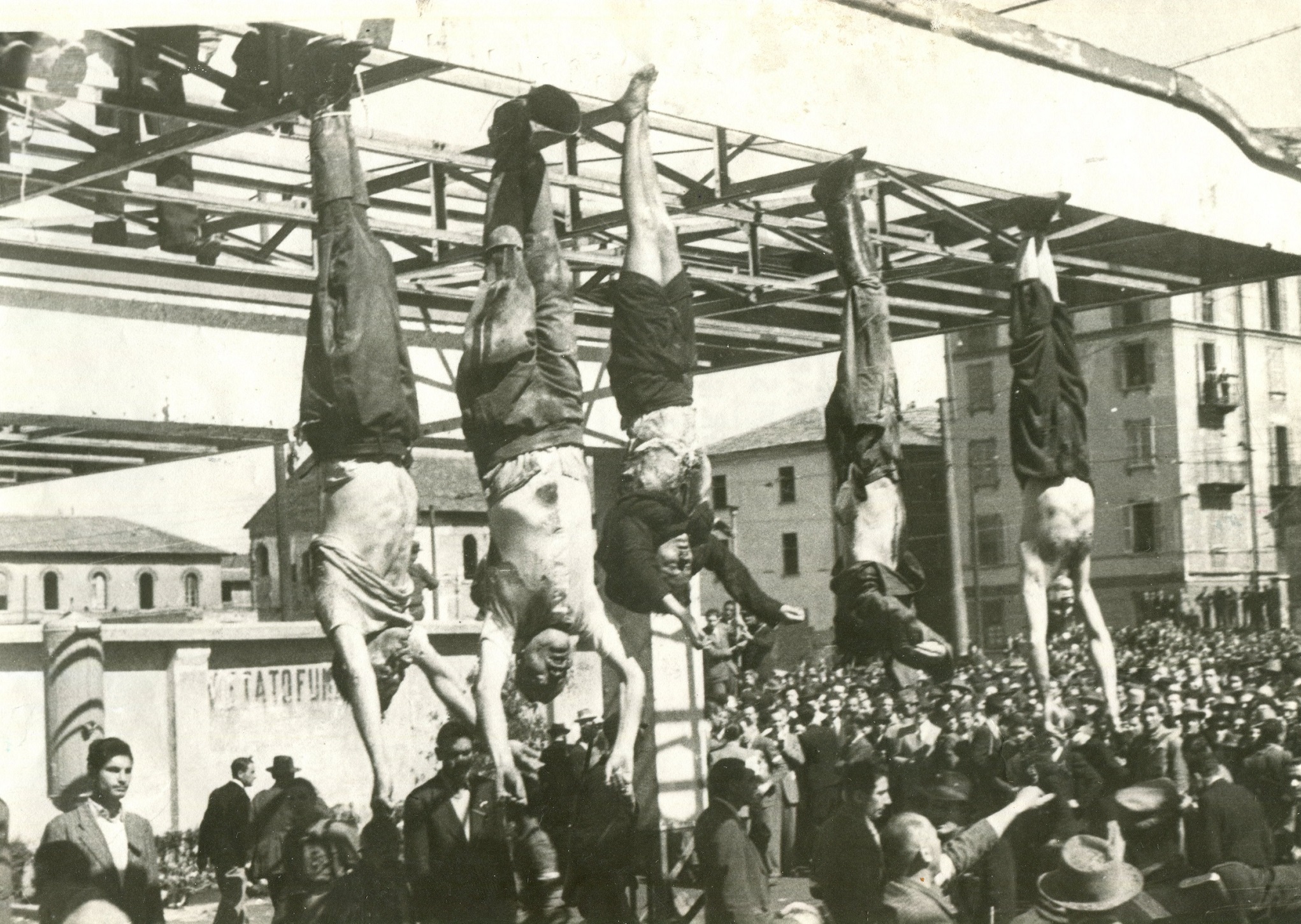
There will be no doubts that Gaddafi has been killed, though the way he died may swathed in mystery. Images of his dead body will also join other iconic images of dead dictators and notorious killers. Amongst them are Saddam Hussein and Benito Mussolini. After being killed Mussolini was photographed hung from his feet alongside other executed fascists in Milan. Saddam Hussein's capture by US troops and his subsequent trial was well documented as was his execution. While officially released footage of the event stopped short of showing the actual execution, an amateur video shot using a camera phone from a staircase leading up to the gallows surfaced, containing low-quality footage of the entire hanging. The amateur footage, unlike the official footage, included sound and witnesses could be heard taunting Saddam at the gallows. There are also some pictures of the former Iraqi dictator lying dead in the ambulance.

Others have escaped being captured on film in their final moments. There are no images of Adolf Hitler's corpse. After he committed suicide by gunshot on 30 April 1945 in his Führerbunker in Berlin he was cremated leaving only some remains which were recovered and interred in successive locations until 1970 when they were again exhumed, cremated and the ashes scattered.

Slobodan Milošević, the former Yugoslavian leader, avoided both a last picture and sentencing at the Hague after he died from a heart attack. Milošević was found dead in his cell on 11 March 2006, in the UN war crimes tribunal's detention center, located in the Scheveningen section of The Hague, Netherlands.

No tears

But whether they left behind iconic images or not there will be few who will shed tears for such tyrants. Gaddafi's death marks a milestone not only for Libya but other countries ruled by tyrannical rulers. In Libya NATO will gradually wind down its operations as the NTC moved forward to creating a new democratic Libya [CNN].

Across the rest of the Arab world and perhaps further afield there will be dictators of one party states feeling a little less confident than they were last week [CNN].

tvnewswatch, London, UK

Friday, October 21, 2011

Dale Farm: "We lost," traveller concedes

By late Thursday it was clear that travellers at Dale Farm had lost their battle with Basildon Council as bailiffs moved onto the site to dismantle some of the plots. Defiance gradually waned throughout the course of the day as it became clear that the cause was lost. With electricity cut off and hundreds of riot police on duty, this was a community under siege.

39 arrests

As the sun rose over the site bailiffs began work to removed the last of the protesters from the scaffolding structure at the entrance to the site. They were shielded by lines of riot police from Kent, Surrey, London and Essex. One by one, the protesters who had chained themselves to the structure, were removed and arrested.

"Well done Josh," shouted one supporter as the first bespectacled protester was taken away by police. He along with the other remaining protesters were taken past a throng of photographers and TV crews before being checked for weapons and removed from the site in a police van.

A total of 39 people had been arrested by the end of the two day operation, charged with various offences ranging from obstruction to violent disorder [Echo]. It was clear that their arrest had not dissuaded some from abandoning their protest however. Some of those arrested the previous day could be seen wandering around the site and continuing to lend their support to the Dale Farm travellers.

Demolition

With the last of the protesters removed from the scaffolding, work on removing the iconic barricade began. A mechanical digger soon pulled down the structure and pushed it to the side of an adjacent field.

There were some delays as gas bottles had to removed by hand. They had been placed within the structure by those defending Dale Farm. Whether there was ever any intention of using them as weapons is unclear, but the presence of more than twenty such items could have posed a serious danger especially in the event of a fire.

With the scaffolding, a van and car removed, police negotiated with the owner of a former Russian army vehicle in order to get it driven from the site. The owner was reported to have initially refused to hand over the keys to police. But by mid-afternoon the dread-locked protester was allowed to drive the large vehicle off the site as a bailiff sat alongside.

Rising tensions

On the site there were moments of tension as protesters and some travellers became agitated at some members of the media. In one instance a traveller attacked a Sky News television crew as a cameraman tried to film paramedics taking away a women on crutches. While one traveller pushed the camera another traveller began to threaten the crew and other members of the media picking op a nearby brick.

Protesters also joined the melee, shouting and pushing members of the press. The situation was defused by traveller women who persuaded the protesters and their men folk to withdraw.

Some photographers who had taken pictures of a young baby, after being requested to by its mother, were also threatened. A large and angry male traveller stormed into the group insisting they delete their images. "No pictures of our kids unless you want that camera in your face," the burly man stormed.

While most of the media has generally been welcomed by travellers, there has been some antagonism shown. In September when hundreds of members of the press gathered for the proposed eviction, some travellers were walking around asking if journalists and photographers were from the local Echo newspaper. "We don't want the Echo here," a traveller said, "because of all the lies they've written about us." He and a friend wend on to pepper their sentiments with a clear threat. "We'll beat the s*** out of them if we find any," one said.

"We lost"

Not all the travellers have been so hostile however. Some have been more than welcoming to members of the press. But it is mostly the women who have been in the public eye. As the afternoon drew on, one of the McCarthy sisters, who had been the public voice of the Dale Farm campaign, told the media that the fight was almost over and that they and the protesters planned to leave the site. The departure would be only a symbolic one since they would return to gather their possessions. "We Lost," Marie McCarthy told journalists [pictured]. "But we put up a good fight, " she insisted.

But then came an impasse as officials from Basildon Council entered the site escorted by squads of riot police. In a surreal and somewhat farcical scene, the two officials were taken from plot to plot surrounded by up to a hundred police in full riot gear. As they moved in formation, they were followed by a throng of media and dozens of travellers.

The action angered many travellers who were upset they had not been informed. Then it emerged that eviction notices had not been brought by Basildon Council and travellers said they would not leave until they had been served with the appropriate paperwork.

"Road to nowhere"

But it was clear the fight was over. Some of the last remaining travellers on the site made the decision to move on, though their destination was unknown. Even some of the travellers seemed uncertain. "We'll be on the road to nowhere," traveller Marie McCarthy said.

By the time the symbolic departure from the site began and the last of the travellers left Dale Farm, media coverage began to wane. Late into the afternoon it emerged that Col. Gaddafi had been captured and killed. With his death the story of Dale Farm also died.

Media coverage

Thursday's frontpages had been emblazoned with pictures of the battle for Dale Farm. But in Friday's press the final throws of the largest traveller encampment barely received a mention [Sun / Mirror / Express / Star / Daily Mail / Guardian / Telegraph / Independent].

There are some questions still remaining however. While the clearance of the site is complete, what is not clear is how Basildon Council will proceed. It is not known where the travellers have gone and there are fears amongst some that they will just become a problem for other councils further afield.

While there has been much criticism of the travellers, protesters, Basildon Council, bailiffs and police, some articles on Friday began to criticise the BBC who were accused of "ludicrous over staffing" by sending some 18 staff to the site to cover events [Telegraph / Daily Mail]. It must be said that many media organisations sent significant numbers of staff to Dale Farm. At times the numbers of media outnumbered the travellers and protesters, especially in the final days.

As the media depart, there still remains some uncertainty over the future of Dale Farm. Although they have no legal right to build or live on the land in many cases, the land is legally owned by the travellers. Some thirty travellers may still be allowed to live on the site in caravans, though permanent structures will have to be demolished. The future of Dale Farm is still an uncertain one [BBCSky News].

tvnewswatch, Basildon, Essex

Wednesday, October 19, 2011

Dale Farm eviction begins

After a long running battle between Basildon Council and travellers at Europe's largest illegal travellers' site, police and bailiffs finally moved in to begin the site clearance in the early dawn on Wednesday. Acting on intelligence that protesters at the Dale Farm site had stock piled offensive weapons to be deployed against those enforcing the eviction, riot police entered the site ahead of bailiffs. 

Tasers fired

They were met with a barrage of missiles including rocks, bricks and liquids. In the brief but at times violent battle, police shot at least two protesters with X26 taser weapons. In the early clashes several protesters were arrested. Protesters attempted to keep police at bay by setting fire to barricades and a caravan was also torched.

Relative calm

By mid morning there was a relative calm and police surrounded the main scaffolding situated at the site entrance. As line of riot police kept back scores of press and the few remaining travellers on the site the slow procedure of removing the protesters on the scaffolding began.

Arrests

At first police attempted to talk to the protesters, but it was clear that they were not willing to leave peacefully. And so began the methodical removal of each of the supporters from the structure, some of whom had chained themselves to the scaffolding.

By late afternoon twenty three people had been arrested and led away, according to Essex Police, with charges ranging from violent disorder to obstruction. But the operation was far from finished. As the sunset over Dale Farm and operations were wound up for the day police remained on site to guard the structure and prevent anyone from reclaiming the fortification. 

Accusations

Travellers have accused the police and Basildon Council of overkill and say several people were injured in the operation. For their part Essex police, backed up by officers from Surrey, Wales and London, insist they acted within the law. Meanwhile the Essex Ambulance Service say they had treated six individuals but that their injuries were minor.

The use of tasers during the operation has been defended by Essex Police who say they were deployed after they faced a serious level of violence.

On Thursday the site clearance is set to continue...
[further reports: BBC / Sky / CNN]

tvnewswatch, Basildon, Essex

Tuesday, October 18, 2011

Price deemed too high in Israel prisoner swap

Gilad Shalit, an Israeli soldier held captive for five years by Hamas, has been released. But it comes at a high price for Israel who have handed over 1,000 Palestinian prisoners over in return.

Shalit was handed over by Hamas to Egyptian mediators, the first move as more than 1,000 Palestinian prisoners were due to be freed. The first 477 were due to be released on Tuesday. Awaiting their return were thousands of supporters who filled the city centre in Gaza.

Terror victims failed by courts

The exchange went ahead after the Israeli Supreme Court rejected a bid by families of victims of militant attacks to delay the swap. Many Israelis object to an individual prisoner release and had appealed to Israel's highest court to intervene. But their concerns were rejected. Amongst those who opposed the prisoner swap was Arnold Roth, whose daughter, Malka, was killed 10 years ago, when a suicide bomber attacked a pizzeria in Jerusalem. A woman convicted of involvement in the attack is among those due to be set free.

"These people who are released are going to become terrorists again. They're going to be inspirational. Many of them are iconic figures and we're going to pay a heavy price"

"We're aiming to have her name removed from the list," Roth told the BBC. "We're doing this principally because we think there is a colossal amount of misinformation about this specific woman. She's actually a monster, on really any view. She's cold blooded and charismatic, she's very attractive to look at and this has somehow bamboozled many of the people who've been reporting about her."

New terror threat

Roth says that prisoner exchanges had no place in civilised society. "She engineered the massacre that led to the deaths of 16 people and 130 injured. And she's been saying for at least five years: 'I'm going to get out. I don't regret a thing'. And she's also said: 'I would do it again'."

"These people who are released are going to become terrorists again," Roth says. "They're going to be inspirational. Many of them are iconic figures and we're going to pay a heavy price." Uzi Landau, an Israeli politician also fears the release will "only encourage" more terrorism and kidnappings.

Sgt Shalit was seized in 2006 by Hamas militants who tunnelled into Israel. He had been feared dead since there was little information exchanged between the two sides and he was refused contact with outside organisations including the Red Cross. But after much negotiation a historic prisoner swap was sealed [BBC]. 

For Sharit there was some clear relief. Speaking to Egyptian TV soon after his release he said, "You cannot imagine how I felt when I heard I would go home." But he said he had always remained optimistic. "It has been a very, very long five years, but I always knew I would go home," he said.

Difficult decisions

While Gilad Shalit's family will be happy to see him it is hardly a cause for celebration for Israel. Amongst the 1,000 Palestinian prisoners being released there are hundreds of convicted terrorists responsible for the deaths of more than 500 people. Amongst them is Marwan Bargouti, who was serving five life sentences in Israel for murder.

Israeli government spokesman Mark Regev said that Hamas had accepted limitations pertaining to the released individuals. He also insisted that Israel was committed to furthering peace talks. But there will be fears amongst many Israelis that a new wave of terror may begin. Many of the released prisoners are being given a hero's welcome by Hamas, and the organisation is likely to be given a boost of popularity.

Hamas popularity boost

Hamas is deemed to be a terrorist organisation by several nations and while it has shifted slightly in its position over the recognition of Israel, there exists a great mistrust of the political party. The boost of support Hamas is likely to receive from this week's events will also detract from Fatah who have made some inroads towards a peaceful solution to the disputes existing between Palestine and Israel. 

For Palestinians there will be much celebration and relief too. But there are still strong divisions within the Palistian community. Sky's Tim Marshall observed that there were many yellow Fatah flags amongst the sea of green Hamas flags in Gaza city. It would be unlikely Fatah would win an election today, Tim Marshall said. "For Hamas, today is their day."

gut-wrenching images

Tim Marshall suggested it was inevitable that some of the released prisoners would return to violence. Such a prospect will be gut-wrenching for Israel. So too will the images being beamed around the world of the Palestinian prisoners arriving on the Rafah border.

The morning's events were carried extensively on Sky News, BBC, CNN International, Euronews, France 24, Al Jazeera, Press TV. There was less coverage on CNN's US feed, Russia Today, and China's CCTV News and CNC. Although it did feature as the top story on RT and CNC, CNN seemed more focused on the western Republican presidential debate while China Central Television was focused on China's economy.

tvnewswatch, London, UK

Thursday, October 13, 2011

Depression rises as recession looms

There has been little optimistic news over the last week, especially for those living in Europe. Greek debt, austerity efforts, protests over cuts and rising unemployment has dominated the headlines [BBC / FT].

On the face of things it is not immediately obvious that Britain is on the brink of a double-dip recession, as some media has been predicting. People are still dining in restaurants, pubs and bars are far from empty and supermarkets are just as packed with shoppers as ever before.

But there are some signs that people are being more careful with their money and that businesses are making greater efforts to draw in extra custom with special offers. Supermarket shelves are lined with 2 for 1 offers and other deals to persuade shoppers to part with their cash. But consumers are still being careful, looking for any way to save on their weekly shop.

The queues in the 99p and One Pound shops say it all. Even in relatively affluent areas such stores are often packed with shoppers looking for savings on everyday items. And in some cases the savings are significant. A simple light bulb may cost as much as £2.50 in any one of Britain's leading supermarkets and yet may be purchased for less than half in discount stores that are taking advantage of people's thriftiness. Breakfast cereals are also significantly cheaper in such stores, though there is obviously less choice.

Consumers are also taking advantage of special offers, free gifts and reduced items. Supermarkets, in particular, often mark down perishable items as they reach their sell-by date. Such reductions can offer rich pickings for the savvy shopper especially if there is a 2 for 1 offer already attached to the items concerned. In a local Waitrose supermarket shoppers eagerly take advantage of price reductions. A £4 pizza already with an offer of a 'buy two and get £2 off' might be priced down to as little as £1.49 each. Due to the checkout system, any customer purchasing two such items will walk away with them for only ninety eight pence.

Those who have plenty of freezer space can take massive advantage of such deals. Customers can often be seen grabbing several pints of milk reduced to as little as nineteen pence which will be thrown into cold storage along with their reduced pizzas and other marked down items.

Fish, meat and vegetables are also reduced significantly on their use-by dates, and such purchases can save shoppers many pounds in their weekly spend. Of course it does require some effort on the part of consumer to hunt out such bargains. Those lucky enough to be in full time employment may be less lucky to grab such deals, both through being too tired to shop after a day at the office or be too late home to take advantage of the offers since most reductions will have disappeared from the shelves by 7pm.

But even for the workers there are some deals out there which can break up the monotony and save a few pennies. Some newly opened businesses may often offer free deals or specials. One such example is the recently opened Vertigo Lounge, a trendy bar come coffee shop on the outskirts of London. To entice customers in, such that they might return, they have a promotion of offering a free coffee to anyone visiting on Wednesdays between 10 am and midday. It was clear from the number of people in the establishment yesterday that many were taking advantage of the free offer. These customers may have also grabbed their free box of cereal by way of a promotion from Kellogg's. The company had posted a bag through resident's post box asking them to leave the bag outside by 9 am the following morning if they wanted a free box of All-bran Golden Crunch, a crunchy wheat bran and mixed cereal pieces with a caramel flavour.

It seems that while there may not be such a thing as a free lunch, there is sometimes the chance of a free breakfast and a cup of coffee!

But a free box of cereal and a cappuccino is not going to sustain the struggling consumer for very long. With rising unemployment, concerns over government debt, the European debt crisis and even concerns that Asia may also be seeing the effects of a deepening recession in the west, the future is far from rosy. Even China's relatively strong economy may be severely dented by the growing economic crisis [CNN / Reuters / BBC / FT].  

In the US there has been a wave of protests under the banner of Occupy Wall Street in recent days [Herald Mail / WSJ / Time]. In Britain protests over cuts to NHS budgets were seen at the weekend in London [BBC]. And across the continent there are raised voices with Greece seeing riots and widespread industrial action [WSJ].

There is no apparent end in sight to the economic gloom predicted, and no-one, least of all the politicians. seem to have a clear solution.

The US, Europe, Britain and many other countries face a long and bumpy ride. For the citizens of these countries, whether they be consumers, tax payers, job seekers or students, the future looks extremely depressing and bleak.

Of course there are some that believe the constant talking down of the economy is not helping matters. In his 1933 presidential address Franklin D Roosevelt declared, "The only thing we have to fear is fear itself..." and went on to say that, "Nameless, unreasoning, unjustified terror which paralyses needed effort to convert retreat into advance."

Bank of England governor Sir Mervyn King's declaration that the financial crisis is worse than the Great Depression is hardly a confidence booster. The Daily Express is at least one paper which, although conceding the European economy is in a "sticky patch", suggests that preaching words of doom and gloom is not helping. Sir Mervyn "appears not so much to be talking us into recession as bawling it through a megaphone," the paper declares. And while there are indeed very serious issues, such as high unemployment and rising debts to be tackled, the Express calls for a more positive outlook. "What we need in the current crisis is a governor of the Bank of England who can build confidence in the markets," the paper says.

Such an approach is sensible, but solutions to the economic problems are also needed. An over stretched global economy, and the farming out of jobs to cheap foreign factories has reduced the western manufacturing base considerably over the fast few decades. The Made in Britain, Made in the USA and other such tags have been replaced by China, Bangladesh, India, Taiwan and Thailand.

While cheaper, and some might argue inferior, products flood the market it comes at a price. Closed factories and a reduced jobs market in the west. Politicians in the west will have a difficult time attempting to balance accusations by Asian countries, particularly China, of protectionism as it tries to re-establish its domestic manufacturing and industrial base. But such a policy is needed if the western economies are to survive. Simply put, without a solid industrial base there are no jobs, and it will not matter how cheap foreign manufactured products are if the vast majority of people are unemployed.

There are tough times ahead, but tough decisions too.

tvnewswatch, London, UK

Thursday, October 06, 2011

Social media mourns death of Steve Jobs

Social networks went into a virtual meltdown on late Wednesday and into Thursday as news of the death of founder and former CEO of Apple, Steve Jobs, spread around the world.

In China alone more than 35 million messages were posted on microblogs while around the world millions more posted to Twitter and Facebook. Hashtags of #jobs, #stevejobs and #apple were top trending subjects and Google trends also showed a sharp increase in searches for Steve Jobs.
Even in the physical world there was an outpouring of grief following the passing of the Apple founder. Outside Apple stores in Beijing [twitpic.com] and Hong Kong [yfrog.com] flowers were laid by fans of Apple products. And in a mark of respect the store in Hong Kong also shut off the illuminated Apple logo [instagr.am].

For the Chinese in particular, the passing of the Apple founder is a shock [techrice.com]. Chinese youth have begun to embrace technology in a big way over the last few years and an iPhone is a much coveted item to the extent that there is a massive market in fake iPhones for those that can't afford the real thing. In fact in the last few days there are already reports of fake iPhone 5s on sale in parts of China ahead of the official release in the west [Sky News].

Steve Job's death was the top item on most news channels including Sky News, BBC, CNN, France 24, Euronews, Al Jazeera and Xinhua's CNC. Business channels CNBC and Bloomberg also focused on the passing of Apple's founder and what his death might mean for the future of the company. Such interest is an indication of the impact Jobs and Apple has made to the world of technology.

His legacy is not only his vision in sleek design deployed in his Apple computers and laptops but also the innovations made in mobile phone technology and in personal entertainment. The iPod changed the face of how people listened to music and the iPhone has brought many imitators and set the standard for smartphone technology. The relatively recent launch of the iPad has also changed the face of mobile computing with competitors launching their own devices.

While there has been criticism of Jobs' walled garden in the way he controls apps made available for his iPhone as well as the methods deployed in his music distribution through iTunes, without Apple there may not have been an Android phone.

Even his imitators and competitors paid tribute to Steve Jobs. Microsoft's Bill Gates talked of the "profound effect" Jobs' had made to the world of technology. Even Google's founders Sergie Brin and Larry Page left their messages of condolence. In a post on Google+ Sergie Brin spoke of the inspiration that Apple gave him. "From the earliest days of Google, whenever Larry and I sought inspiration for vision and leadership, we needed to look no farther than Cupertino. Steve, your passion for excellence is felt by anyone who has ever touched an Apple product (including the macbook I am writing this on right now). And I have witnessed it in person the few times we have met. On behalf of all of us at Google and more broadly in technology, you will be missed very much. My condolences to family, friends, and colleagues at Apple."

The tributes came from as high as the US president with Barack Obama saying the world had "Lost a visionary."

Apple co-founder Steve Wozniak spoke of a pretty solid legacy left behind, but there are some doubts for the future of the company. Fans of Apple products outside a store in China wondered whether Apple would remain number one in the technology market. Such concerns could also be seen in the markets. In Germany shares in Apple fell as much as 2.5% after the announcement of Steve Jobs' death [Business Week].

On the day he died at the age of 56, exactly six weeks after resigning as CEO of the company he co-founded, Apple was the second-most valuable company in the world. Following Tim Cook's appointment as Apple CEO on August 24th, shares have increased some 9.9%. But it remains to be seen whether such growth will be maintained [Money MSN].

One American fan of Apple products was optimistic for the company's future. Speaking to Sky News outside a store in London he said, "When Jesus died religion didn't stop." The future lies in how much a part of Apple Steve Jobs was and whether he left behind a team that has the same sense of vision and passion for innovation.

tvnewswatch, London, UK

Thursday, September 29, 2011

Terror threat “more real than ever”

This week six men appeared in a British court accused of terror offences, three of whom are believed to have been planning a suicide attack [Guardian / Telegraph / BBC / PA]. Meanwhile in the United States an American has been charged with plotting to fly remote controlled planes packed with explosives into the Pentagon and the Capitol building in Washington [BBC / Telegraph / San Francisco Chronicle].

The plots reveal that that the threat of terrorism remains real. But while authorities are still focused in thwarting potential terror attacks, the public is becoming increasingly complacent and less vigilant. The breaking up of both terror plots was reported but failed to make the front pages it might have done only a few years ago.

And there is even a sense of complacency displayed by the courts as is was revealed this week that at least eleven foreign-born terrorists who should have been deported from Britain after finishing prison terms are still walking the streets [Telegraph / Daily Mail].

There are some who maintain the terror threat is exaggerated. Conspiracy theorists continue to assert that the US were complicit in the 9/11 attacks, a view that even some of America's enemies have aired. During a recent UN meeting in New York the Iranian president Mahmoud Ahmadinejad caused consternation as he accused the United States of killing Osama bin Laden in order to help cover up the 9/11 attacks which he claims were a "big fabrication".

The US has criticised Ahmadinejad and dismissed such theories. But this week al-Qaeda joined America in warning Iran's President Mahmoud Ahmadinejad against spreading September 11th conspiracy theories. "The Iranian government has professed on the tongue of its president Ahmadinejad that it does not believe that al-Qaeda was behind 9/11 but rather, the US government," an article in a recent copy of  Inspire, a magazine run by Al Qaeda's branch in Yemen, said. "So we may ask the question: why would Iran ascribe to such a ridiculous belief that stands in the face of all logic and evidence?"

Such assertions would indicate that al-Qaeda are still serious and committed in their war against the west. It would be a mistake for the west to become complacent in the light of recent events and threats [Telegraph / Daily Mail / Guardian / Globe & Mail].

tvnewswatch, London, UK

Wednesday, September 28, 2011

Dale Farm campaigners apply for listed status

Campaigners have applied to English Heritage to obtain listed status for a scaffolding structure which stands at the entrance to Britain's largest illegal travellers' site. The structure which is festooned with protest banners and flags was erected around 2006. The campaigners claim the scaffolding structure is an "emblem of a struggle for traveller rights". English Heritage has not commented on the application.

On Wednesday it was also revealed that two Dale Farm protesters have been charged in connection with an incident at Basildon Council offices. The men, aged 22 and 29, have both been charged with using threatening words or behaviour to cause harassment alarm or distress following Tuesday's incident. They were bailed to appear at Basildon Magistrates' Court on 6th October [BBC].

While the clearance of the Dale Farm site had been due to begin on Monday September 19th it has been delayed by an injunction preventing bailiffs moving in. On Friday Basildon Council attempted to appeal the injunction, however a decision was delayed until Monday this week.

After a day of legal arguments Justice Edwards-Stuart extended the temporary injunction preventing Basildon council from clearing the site until a separate hearing examining a potential judicial review of the decision takes place on Thursday 29th September. But even if the council wins that case, it will be prevented from carrying out work on much of the site until another hearing on Monday 2nd October, which will examine the enforcement notices.

Speaking outside the court on Monday a visibly frustrated councillor Tony Ball said, "What we've seen today is the wheels of justice grinding slowly forward, but I would like to say it's been a good day for Basildon's residents and for the majority of people who support the council's stance on this issue." Directing comments to residents of Crays Hill who live close to the site he said, "The message I can give to them, is that we are getting there." [Sky News]. Local Conservative MP Mr Baron also spoke of his optimism that the site clearance would take place soon. "The judge made clear that the enforcement notices are valid - its been to the highest court in the land," Baron told the BBC, "The bottom line is, this site clearance will take place."

Residents were less than optimistic however. Breaking their silence for fear of reprisals, some said they were themselves willing to break planning regulations if the situation was not resolved soon [BBC].

On Wednesday the site was quiet with only a lone camera-shy campaigner on the front gate. In the field adjacent there was little activity with only few bailiffs patrolling the vast compound. The media presence was also much diminished with only a single satellite truck parked up.

Update: On Thursday it was reported that the bid to obtain listed status for the scaffolding structure was rejected by English Heritage [Sky News].

tvnewswatch, Basildon, Essex

Pigs on the wing

"There is no dark side of the moon, as a matter of fact it's all dark", an immortal line from Pink Floyd's 1973 album The Dark Side of the Moon. But for Floyd fans, this week has been bright and exciting with the re-release of all of the bands 14 albums along with some previously unreleased material.

EMI promoted the launch of what it calls "Why Pink Floyd...?" with another relaunch, that of Algie the pig which featured on the band's 1977 album Animals.

This pig had to be specially commissioned at the last minute since the original was found to be leaky and not airworthy some two weeks before the intended publicity event. Due to building work at Battersea Power Station, where the original album cover was shot, the pig had to be raised from the river side. This was a disappointment for some who had hoped to capture an exact recreation of the original photoshoot.

There were added difficulties for those taking pictures of the event as they were shooting directly into the sun. For the crew raising the 10 metre long inflatable pig there were problems too as they encountered fairly strong westerly winds. The pig was lowered several times throughout the day for fears it might break free. The original pig, Algie, had escaped during the 1976 photoshoot, causing air traffic over London to be halted for a time. It eventually landed in a farmers field in Chilham, Kent, some 80 km to the south-east.

The delays during Monday's publicity stunt created only frustration as onlookers waited for the pig to be raised with some gaps of up to 90 minutes. Each time the pig took to the air again there was a flurry of excitement as photographers, fans and passers-by snapped away.

The event was eclipsed only by the Labour party conference, though the Daily Telegraph made use of the iconic image to poke fun at shadow chancellor Ed Balls, depicting him as the pig over an upturned table, with scattered policy documents beneath.

There is perhaps irony here, in that the pig, and indeed the album itself had been inspired by George Orwell's Animal Farm, and where the pigs were depicted as the tyrannical leaders in a hierarchical Stalinist society.

Of course, while many of the underlying themes in Pink Floyd's music are dark, with strong political overtones, most people are drawn to the music. The re-releases promise to enthral fans with not only digitally remastered versions of all 14 albums but also an array of special DVD presentations and unreleased material.

However, the back catalogue of material does come at a price. While some fans may have a disposable income to buy the new releases, a large majority of music lovers may be resigned to listening to their old vinyl or CD releases.

The box set, consisting of all 14 albums, is set to retail at £130 [$200]. In addition there are special releases of some of the albums themselves each containing unreleased DVD recordings as well as early unreleased album mixes. It is not clear if all 14 albums will be released as separate box sets. The Dark Side of the Moon and Wish You Were Here are already on sale retailing at around £88 [$137] and a 7 disc special edition of The Wall is on pre-order. But there will be few fans that will be so extravagant to buy the entire back catalogue. 

With a double dip recession looming fans will balk on spending such large sums on entertainment. In fact most Floyd fans would likely be thinking to "grab that cash with both hands and make a stash", rather than buy "a new car, caviar, four star daydream" or even Pink Floyd's digitally remastered back catalogue. Of course pigs may fly!

tvnewswatch, London, UK

Friday, September 23, 2011

Will China’s bubble burst as global economy slides?

There are rising concerns that the global economy is heading for a down-slide and that implications will be far more wide reaching than already seen since the 2008 recession.

There is a particular focus on China's economy which is beginning to show signs of a decline. This week, the International Monetary Fund scaled back its projections for GDP growth in China, and an HSBC flash purchasing managers' index projection fell below 50 for a third-consecutive month, driving markets down and feeding fears that even the world's second-largest economic engine will not be able to help drive the global economy.

Barometer

"China is a kind of barometer for the world economy, so [slowing] in the Chinese economy does spell, at least in the short term, a weakening of global demand," says Li Wei, a professor of economics with Beijing's Cheung Kong Graduate School of Business. "Countries [that were] largely pulled by the Chinese demand out of the last recession, with China weakening, cannot rely on China being the locomotive for growth any longer."

The IMF has cut its forecast for China's GDP growth slightly for this year, from 9.6% to 9.5%, and lowered its 2012 forecast from 9.5% to 9%. Although the numbers are still enviable, and above the 8% policy target outlined by Chinese leaders earlier this year, the slip coincides with evidence that China's manufacturing industry is slowing [Globe & Mail].

The preliminary HSBC China manufacturing purchasing managers index fell to 49.4 in September from a final reading of 49.9 in August, HSBC Holdings PLC said Thursday this week. A reading below 50 indicates contraction from the previous month, while a reading above 50 indicates expansion. Such a decline in the PMI could reignite some concerns over a sharp economic slowdown in China, due to weakening global demand for Chinese goods and various tightening measures at home [WSJ].

Repercussions

Such a decline could have wide ranging and far reaching effects. The Australian dollar, which is sensitive to Chinese demand for Australian commodities, slipped after the data were released, falling below parity to the US dollar for the first time since August 8th.

Asian stocks in turmoil

Stocks of Asian companies trading in the United States also fell sharply Thursday after the preliminary report on China's manufacturing activity. The BNY Mellon ADR was down 4.22%, while the BNY Mellon China Select ADR, which focuses on Chinese companies, was down 5.1%.

Shares of some individual Chinese companies that trade in the US also fell. Solar-module maker Trina Solar Ltd. saw its stock fall by 45 cents, or 5.8 percent, to $7.30. Shares of Internet search company Baidu Inc. fell $15.33, or 11.1%, to $123 and coal producer Yanzhou Coal Mining Co. Ltd. dropped $2.73, or 11.2%, to $21.61. Youku.com Inc. also fell $1.56, or 9.6%, to $14.65.

Across the Asian stock indexes there was also a strong indication of uncertainty and concern. The Japan's Nikkei 225 closed down 2.1% while South Korea's Kospi slid 2.95 and the Hong Kong's Hang Seng falling 4.9%. And in mainland China, the Shanghai Composite Index fell 2.8% to close at 2443.06 [Business Week].

The reaction in Asia was not just down to the HSBC assessment of the Chinese manufacturing industry however. This week the Federal Reserve warned of major risks to economic growth which increased concern amongst investors around the world. US stocks suffered their worst drop in a month overnight after the Fed's cautious comments [CNN], driving investors to buy the US dollar as a safe haven. And a weaker euro dragged down export-related shares, with Honda Motor leading the losses, falling 3.9% [RTT News].

While the US and European economic situation was a major factor affecting financial markets, China was a focus of many analysts. "Further indication of contraction in China's manufacturing sector is clearly not helping," Deutsche Bank analyst Colin Tan said [CNN]. 

John Higgins, senior markets economist for Capital Economics, said that the slowdown in manufacturing in China was a worry given the importance of China's role as the engine of global growth as the world came out of the 2008 recession. "There is a broad brush concern that even if the Chinese economy is not shrinking, it is slowing, and that slowing is bad news for the rest of the world," Higgins said [CNN].

But the long term effects may be even worse than some are predicting. A paper published last year points to China's economic bubble bursting with dire consequences, not only for China but for the rest of the world.

Risks of a China bubble burst

In a Symposium of Views [PDF], a report compiled by International Economy based in Washington, experts across a wide field aired their views on how such an economic decline in China might affect both China and the world.

The opinions are mixed, but there was a general consensus that such a scenario would not only affect China. Maya Bhandari, Head of Emerging Markets Analysis at Lombard Street Research, said that surrounding export hubs would be affected, with global growth hit significantly.

Tadashi Nakamae, the President of Nakamae International Economic Research, also painted a bleak picture saying that many foreign investors would be particularly hard hit. "China has created a bubble in its productive capacity that is even more dangerous than its asset price bubble. The former is the inevitable result of over- investment in capital expenditure and building an export-led economy," Nakamae says. "When capital investment is booming, say, when steel factories are being built, this itself creates extra demand for steel that cannot be sustained, especially once the factories become operational and become units of supply rather than demand. China is a typical case of a capital investment-led boom-and-bust economy."

"Expansion of investment is mainly supported by exports. Once exports start deteriorating, economic growth halts. Exports decline, as does capital investment, leading to a sharp drop in overall demand. It becomes increasingly clear that the country [China] has huge over-supply in capacity. Prices decline and a deflationary recession develops," Nakamae suggests.

And he drew analogy to past history. "Immediately after Lehman Brothers collapsed, China's nominal GDP growth rate fell from its peak of 24% in the fourth quarter of 2007 to a mere 3.6% in the first quarter of 2009. Its GDP deflator fell from 12.3% to a negative 3.7% in the same period. The Chinese government tried to deal with this by stimulating bank lending, mostly for infrastructure projects by regional governments. Banks also lent a considerable amount for speculative real estate investments. The problem with regional governments using bank lending rather than tax revenue to finance public works projects is that these do not create a return on investment. Servicing the debt is all but impossible, leaving banks holding potentially enormous bad loans on their books."

He also points to Beijing's inability to control the certain parts of the economy. "While China's asset price bubble is worth monitoring, its capital investment-led boom and bust is far more dangerous, and this looks to be already beyond the control of its central authorities," Nakamae warns. "This will have far- reaching negative effects globally, but the biggest victims will probably be foreign companies already invested in China. If the collapse is sudden, the Chinese government should guarantee the property and all other assets of foreign companies leaving China."

While Chinese authorities have accumulated vast reserves Chen Zhao, the Chief Global Strategist and Managing Editor for Global Investment Strategy at the BCA Research Group, warns that a bursting China bubble would be a "massive deflationary shock to the world economy."

Threat to Beijing

There are some who believe such a situation would also be devastating for the Chinese leadership. Marshall Goldman, a Senior Scholar at the Davis Centre for Russian and Eurasian Studies at Harvard University, suggests that the Chinese themselves would be the most affected. "Both domestic and foreign investment in China would suffer and result in a sharp drop in production and employment. That in turn might have domestic political consequences, possibly resulting in a governmental upheaval." It is an opinion held by Gary Hufbauer, a Senior Fellow at Reginald Jones of the Peterson Institute for International Economics.

"Collapsing Chinese asset values would devastate China and many millions beyond the Middle Kingdom," Hufbauer asserts. "Hardest hit would be party leaders in Beijing. It's questionable whether the technocrats could survive a 50% drop in property values."

But he too also warns of wider affects. "Beyond China's own borders, manufacturing supply chains across Southeast Asia and commodity producers from Australia to Brazil would all take a drubbing. A new aphorism is born: China sneezes, its partners catch pneumonia."

Others might benefit

However Hufbauer speculates that some economies might benefit if China floundered. "Perhaps the biggest beneficiary would be India. Lower oil and raw material prices, openings for its manufactured exports, and a burnished reputation for growth and stability."

Ernest H Preeg, a Senior Advisor for International Trade and Finance for the Manufacturers Alliance/MAPI, also believes India would be the biggest winner. "The biggest net gainer would be India, with relatively small exports of manufactures and business services to China at risk," Preeg says. "India would emerge touted as the new  number-one high-growth emerging market, with balanced and therefore sustainable 8–10% growth, which would attract increased foreign investment, in part at Chinese expense, to reinforce its new status."

US-China ties at risk

China might also see tensions in its relationships with other countries, should its bubble burst and its economy took a serious down slide. Bowman Cutter, a Senior Fellow and Director within the Economic Policy Initiative at the Roosevelt Institute, and former Managing Director of Warburg Pincus, says the United States' relationship with China could become particularly strained. "The most important consequence of a major "China Bust" would be an almost inevitable political and economic crisis in the China-U.S. relationship," Cutter says.

But he says such a major economic and financial crisis in China would have to be on a scale such as that seen in the US since 2008. Such a crisis is "extremely unlikely" Cutter maintains.

Nonetheless, it is clear that China is beginning to feel the affects of the economic problems that are increasing in Europe, Britain and the US. Some believe that if the situation worsens China could even become hostile [Financial Sense] though such prospects again are also highly speculative.

Interconnected world

IMF Managing Director Christine Lagarde today spoke of an "interconnected world" and called for countries to come together to solve the economic crisis and prevent contagion spreading from areas such as Greece and other vulnerable regions.

The G20 has vowed to tackle the economic crisis [Bloomberg] and leaders across Europe have called for action. But there seems to be little resolve nor a definitive response.

Uncertainty raises fears

Despite G20 assurances, shares once again took a battering in Friday's trading [BBC]. Negativity concerning weak global growth from the International Monetary Fund and the World Bank knocked sentiment further. On Thursday, IMF head Christine Lagarde said the global economic situation was entering a "dangerous place", while World Bank president Robert Zoellick said he thought the world was in a "danger zone".

British PM David Cameron has warned any failure to act swiftly over the Eurozone's debt problems would "lengthen the shadows of uncertainty" looming over the global economy. In a speech to the Canadian parliament, Cameron called on European nations to show they had the "political will" to "do what is necessary".

"Endlessly putting off what has to be done doesn't help, in fact it makes the problem worse, lengthening the shadows of uncertainty that looms over the world economy," Cameron said. "We are not quite staring down the barrel, but the pattern is clear, the recovery out of the recession for the advanced economies will be difficult," he added [Sky].

China's economy 'still strong'

There are those who think that China, despite its fall in productivity, is still in a position to bail out ailing economies [BBC]. For its own part China remains upbeat despite the International Monetary Fund lowering its estimate for China's growth for 2011 and 2012. Data from the People's Bank of China on Wednesday suggested financial institutions' yuan positions had a net gain of 376.94 billion yuan [$59 billion] in August, 72% more than in July and the biggest increase in five months. The numbers suggested a surge in flows of speculative capital into China as investors bet on the nation's growth and prospects for gains in the yuan an article, published by Xinhua, claims.

The uncertainty and pessimism over financial markets is likely to continue for many months to come, not only in the Eurozone, Britain and the US but also China and economies further afield.

tvnewswatch, London, UK

Thursday, September 22, 2011

Social media wars: Google+ vs Facebook

Google+ went live for everyone this week, but getting people to adopt the new social networking site may prove difficult [ZDNet]. While the layout, design features, privacy features and relative ease of use of Google+ is excellent, it is the usual case of trying to get anyone else to use it that makes it somewhat pointless. Since Google+ is about sharing content, be that photos, links, video etc, with friends, one obviously needs some friends. But how to get some friends when they're either happier staying on Facebook, can't be bothered with opening up a Google+ account, can't see the point anyway, or are such Luddites they wouldn't know what to do with it anyway.

Getting used to Google+ is not a big deal. One posts in the same way one does with Facebook or any other social media website. However Google+ offers the facility to share that post with all your friends or just a select few. It does this by way of circles. As a user of Google+ one can add other friends to different circles. For example close friends could be dropped into the 'Friends' circle while general friends with who one may not be so close to could be placed in the 'Acquaintances' circle. There is a 'Family' circle for mum, dad, the wife etc., and of course you can make new circles for business associates, college mates or any other group one likes.

Pictures and video can be posted easily either the computer or from online folders stored in Google's Picasa Web account. Of course one may wish to move all those snaps posted on Facebook. There are two ways to do this. One is to Go through settings of the Facebook account and select the download all data option. A zip file is then sent after being compiled and the photos may then be uploaded to Google+ via Picasa web. However there is a  simple tool that can facilitate transferring all those pictures through the use of an extension which can be incorporated into Google's Chrome browser. Move2picasa simply connects to Facebook, identifies the folders containing pictures and offers to upload them to Picasa by a simple press of a button. Some 2,000 pictures took less than 2 hours on a fast cable connection. The drawback is that captions and tags will be lost, but the transfer is otherwise painless. From there one can simply add the folders to Google+ with just a few clicks, and since they are already stored in the cloud within Picasa Web, there are no upload waiting times.

But despite the ease of use, and even of transferring data, one may not be sharing your pictures or posts with anyone. Even before Google+ went live for everybody, few people took advantage of invitations sent out to them. It was the same with Google Wave. That began as invite only and there was a select few that became excited sharing invites and playing with Google's new toy. But shortly after it went live for everyone Google abandoned the project.

So where does that leave Google+? Will it flounder amongst the quagmire of other social networking sites? Has Facebook already got the upper hand?

Some people may indeed use both Facebook and Google+. Indeed there are individuals who use a multiplicity of social networking sites and online tools. Facebook remains highly popular mostly because other friends and acquaintances use it. Facebook claims to have some 750 million users. Twitter by comparison has a mere 200 million users.

Both mediums would do much better but for the fact they are censored in some parts of the world, most notably China. As such they are unable to compete for a lucrative online market. Homegrown Facebook clone Renren claimed in February this year that it had 160 million registered users though it modified that statement in April saying it had "a total of 31 million active monthly users."

Sina Weibo, China's most popular micro-blogging platform, has 140 million registered users. Both are relatively small compared to Facebook and Twitter, but the numbers are growing exponentially as more people get online in China, despite strict censorship.

That censorship has also affected Google's move into social networking. The very next day after Google+ was launched in June, China's censors blocked the site [Guardian].

However since Google's run in with Chinese authorities some 18 months ago over hacking claims and censorship, Google is more likely to be focused on markets outside the Middle Kingdom.

On a positive note it may do well if disgruntled Facebook users migrate in its direction. And this week there were many posts on the social networking site complaining about new changes to the site.

Writing in Salon.com, Andrew Leonard complained that Facebook has once again decided what it thinks its users want to read. "Facebook has changed its user interface, again. Gone is the "Most Recent" button, which allowed users to see what their friends have posted in a simple, straightforward, chronological order. Now Facebook is indulging, again, in outright effrontery: employing its own secret algorithmic sauce to highlight what it considers the most important "top stories," while mixing in other recent posts far below," Leonard lambasts.

He also criticises the real-time Twitter-like stream of status updates from friends. "People don't want Facebook deciding what's most important, Facebook's suggestions were wrong, irrelevant and insulting, and why oh why oh why can't Facebook leave a good thing alone?"

He was not the only one. There are dozens of complaints across the social platform. One user wrote, "WTF??? Why can't they leave things alone. just when you get used to one layout they bloody change it!!!! NOOOOOOOOOO!!!!!!!!!!" and posted a picture eith the text: "Dear Facebook, your new update sucks giant balls, Sincerely your 500 million users".

For many users the changes are an intrusion, with many unwanted posts suddenly appearing in the 'news stream' of supposedly important updates. And along with the Twitter-like stream which has rolled out to some users, it has increased the clutter on the website [Economic Times / Washington Post].

"Now, News Feed will act more like your own personal newspaper," Mark Tonkelowitz, an engineering manager at Facebook, wrote on the company's blog. But many users do not want their news on Facebook. Most people use the site to connect with friends, to check out what they've been doing, see recent photos and perhaps to chat. For those interested in news there are plenty of portals where this can be obtained, from websites, Twitter, the TV and radio.

Of course, Facebook is essentially free, and some have questioned why they are complaining [ZDNet / Huffington Post]. But it does seem to matter to a lot of people. The top trending subject on Twitter this week was less to do with the news and economy, but more to do with the new look to Facebook [Twitter].

Whether the changes are enough to make people switch to Google+ or just drop the whole social networking thing altogether is debatable. Previous changes and even issues over privacy has not dented the user base of Facebook, in fact if anything the numbers of people using it has grown. However, with Google+ going live to everyone there is now a choice [Wikipedia].

tvnewswatch, London, UK